
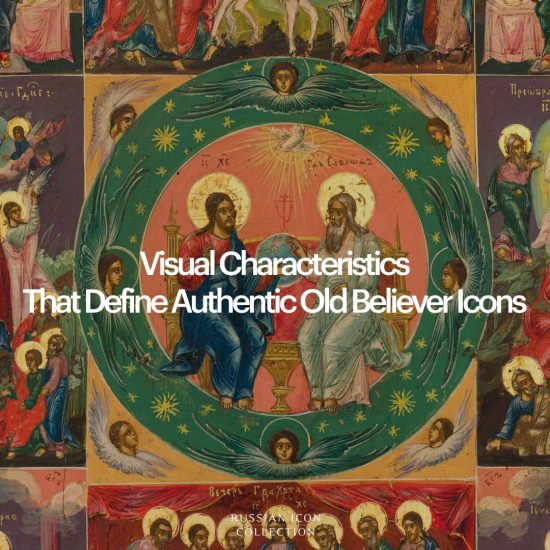
Visual Characteristics That Define Authentic Old Believer Icons
The history of Old Believers in Russia is marked by persecution, exile, and remarkable cultural resilience. After opposing the church reforms introduced by Patriarch Nikon in the 17th century, many Old Believers fled to remote regions such as the Russian North, the Urals, and Siberia. There, they preserved not only their religious traditions, but also a distinctive artistic language. Today, Old Believer icons are valued not only as sacred objects but also as powerful symbols of spiritual endurance and cultural identity.
Why Did Old Believers Resist Reform?
Before Nikon’s reforms, Russian Orthodoxy had developed for centuries in relative isolation from Constantinople and the wider Orthodox world. This led to unique liturgical practices, iconographic traditions, and rituals. Nikon sought to align Russian worship with Greek Orthodox standards, but many believers viewed the reforms as a betrayal of the ancient faith.
The reforms were enforced aggressively, and resistance was met with persecution. Those who rejected the changes became known as Old Believers because they defended the “old” rites, prayers, and artistic traditions of Russian Orthodoxy.
Key Visual Features of Old Believer Icons
The isolation of Old Believer communities helped preserve pre-reform icon painting techniques that had disappeared elsewhere in Russia. Authentic Old Believer icons can often be recognized by several distinctive characteristics:
- Deliberate visual archaism. Old Believer painters rejected Western-influenced naturalism, perspective, and dramatic chiaroscuro. Figures appear frontal, elongated, and spiritually detached from the physical world.
- Traditional egg tempera technique. Icons were painted with egg tempera on gessoed wooden panels. Flesh tones were built using the ancient Sankir method, beginning with a dark olive-brown underlayer followed by translucent highlights.
- Strict adherence to iconographic models. Old Believers preserved podlinniki (originals) that dictated the appearance of saints, garment colors, inscriptions, and gestures. Innovation was discouraged; fidelity to tradition was essential.
- Dense inscriptions and symbolic detail. Authentic works often include extensive Church Slavonic inscriptions, carefully rendered halos, and intricate ornamental borders that emphasize the sacred nature of the image.
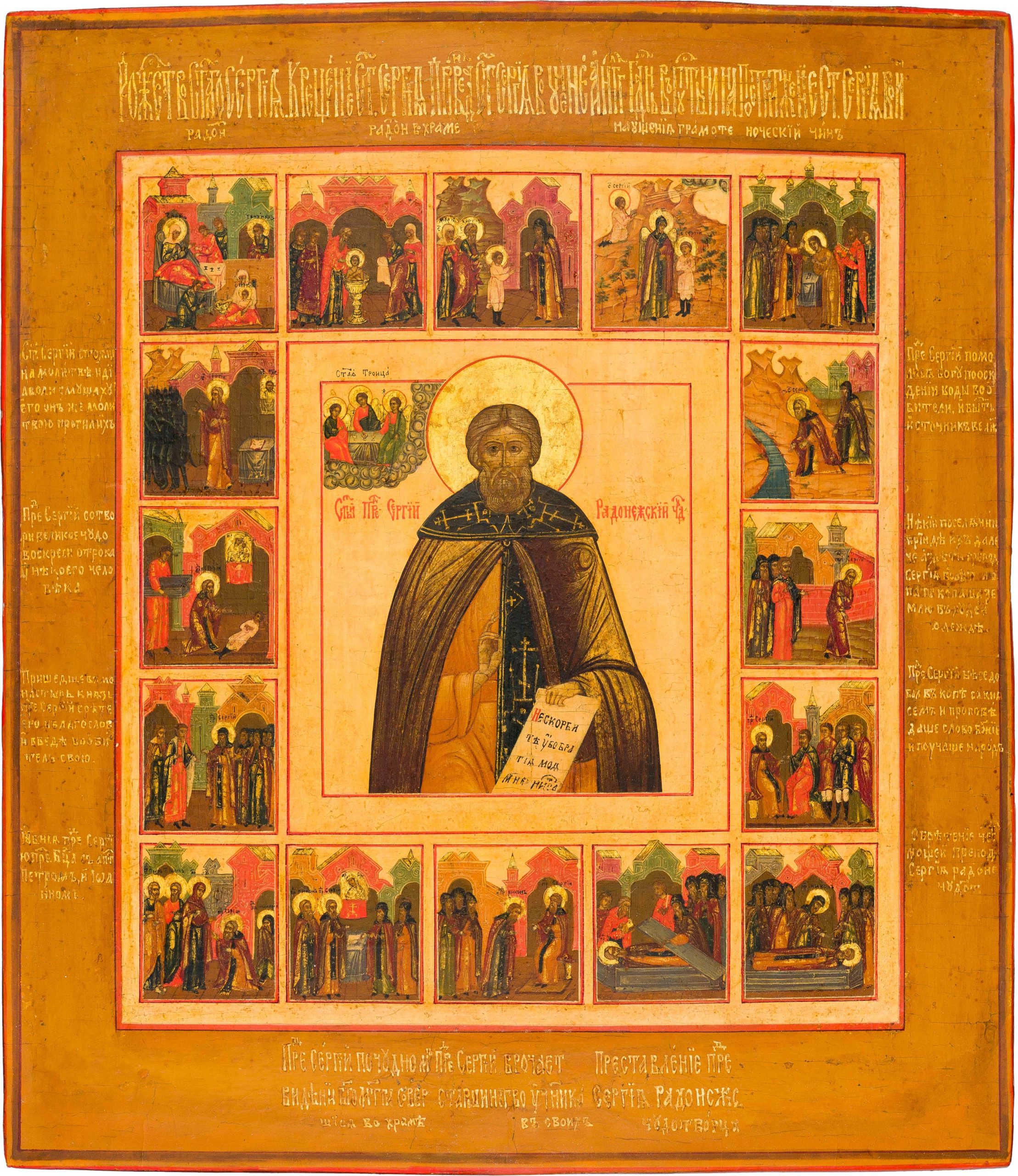
An Old Believer icon from the Oleg Kushnirskiy Collection. Saint Sergius of Radonezh, with 16 Hagiographical Border Scenes. Second half of the 19th century. Moscow region (possibly Guslitsy).
Regional Diversity within the Tradition
Old Believers were not a single unified community, and different regional schools developed their own stylistic nuances. The Vyg school in Karelia favored austere compositions, while the Mstyora and Palekh workshops in the Vladimir region became known for refined craftsmanship and delicate ornamentation. In the Urals, the Nevyansk school produced richly detailed icons with distinctive facial types and decorative backgrounds.
Many of these regional traditions are represented in the collection and catalog of Oleg Kushnirskiy, which includes many examples of authentic Old Believer icons. Together, they reveal how a persecuted religious movement succeeded in preserving one of the most conservative and spiritually charged traditions in Russian sacred art.