
Palekh and Mstyora Icon Painting: Art Born in Isolation
The traditions of Palekh and Mstyora icon painting originated in the villages of Palekh, Mstyora, and Kholuy in Russia’s historic Vladimir Province, where skilled icon painters established workshops that flourished during the 17th and 18th centuries. Their remote location was no coincidence. Many Old Believers fled these areas to escape persecution by the official Russian Orthodox Church and preserve their traditional faith and artistic practices. As a result, local icon painting developed into a distinctive craft shaped by isolation, spiritual devotion, and remarkable artistic continuity. Today, surviving icons from these schools remain highly valued by museums and private collectors worldwide.
The Old Believer Tradition in Iconography
The history of Palekh and Mstyora icon painters is closely connected with one of the most significant events in Russian religious history: the Schism of the 17th century. Patriarch Nikon introduced reforms intended to align Russian Orthodox practices with those of the broader Orthodox world. Many believers rejected these changes, insisting on preserving earlier traditions.
The consequences were severe. Thousands of Old Believers faced persecution, imprisonment, torture, and execution, while many others fled to remote regions, including the Ural Mountains, Karelia, and isolated villages throughout central Russia.
As persecution gradually eased in the early 18th century, Old Believer communities regained the opportunity to build churches, chapels, and private prayer houses. Palekh, in particular, experienced a cultural revival during the early 19th century. Local painters looked back to the refined Stroganov school of icon painting, developing an elegant style that became especially popular among Old Believer patrons.
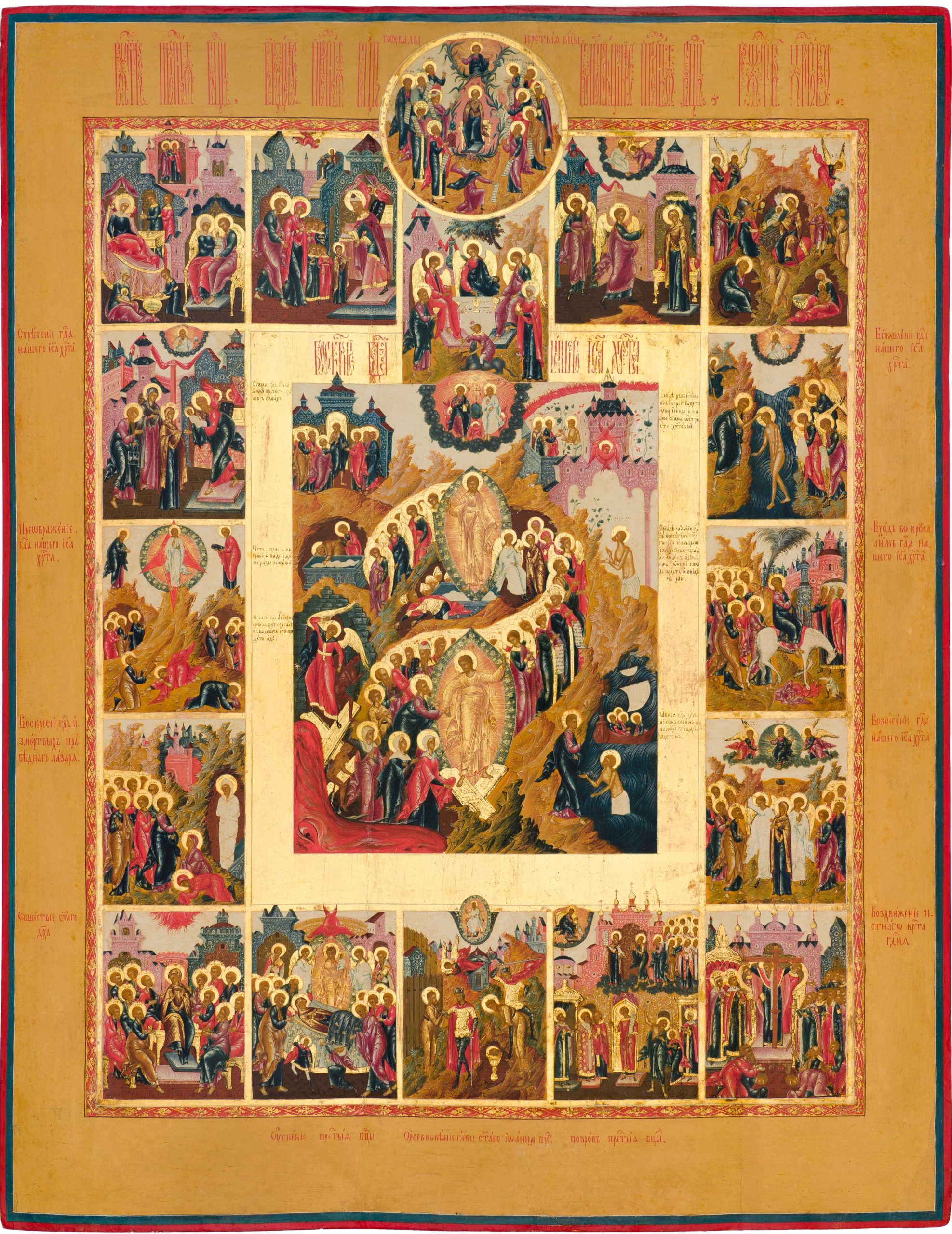
The Resurrection—the Descent into Hell, with the Praise to the Mother of God and Church Feasts in 16 Border Scenes. End of the 18th century. Palekh. The Oleg Kushnirskiy Collection.
Distinguishing Features of Palekh and Mstyora Icon Painting
Although often mentioned together, Palekh and Mstyora icon painting have distinct characteristics. The Palekh school is known for the subtlety and sophistication of the painting technique, elongated figures, complex multi-figure compositions, and masterful attention to the finest details. Its artistic language combines elements from various iconographic schools, as well as later influences, which have shaped its decorative, refined, and easily recognizable style.
The development of Mstyora icon painting was largely shaped by the Old Believer community in Mstyora, where ancient models and traditional techniques were highly valued. The Mstyora masters reproduced the style of early icon painting and iconography so skillfully that their works were sometimes mistaken for pre-Nikonian ones, and the masters themselves were called starinshiki (masters of the old craft). They not only followed ancient models but also worked brilliantly within the traditions of various schools of Old Russian icon painting, creating both austere works inspired by medieval imagery as well as richly and meticulously executed commissioned icons.
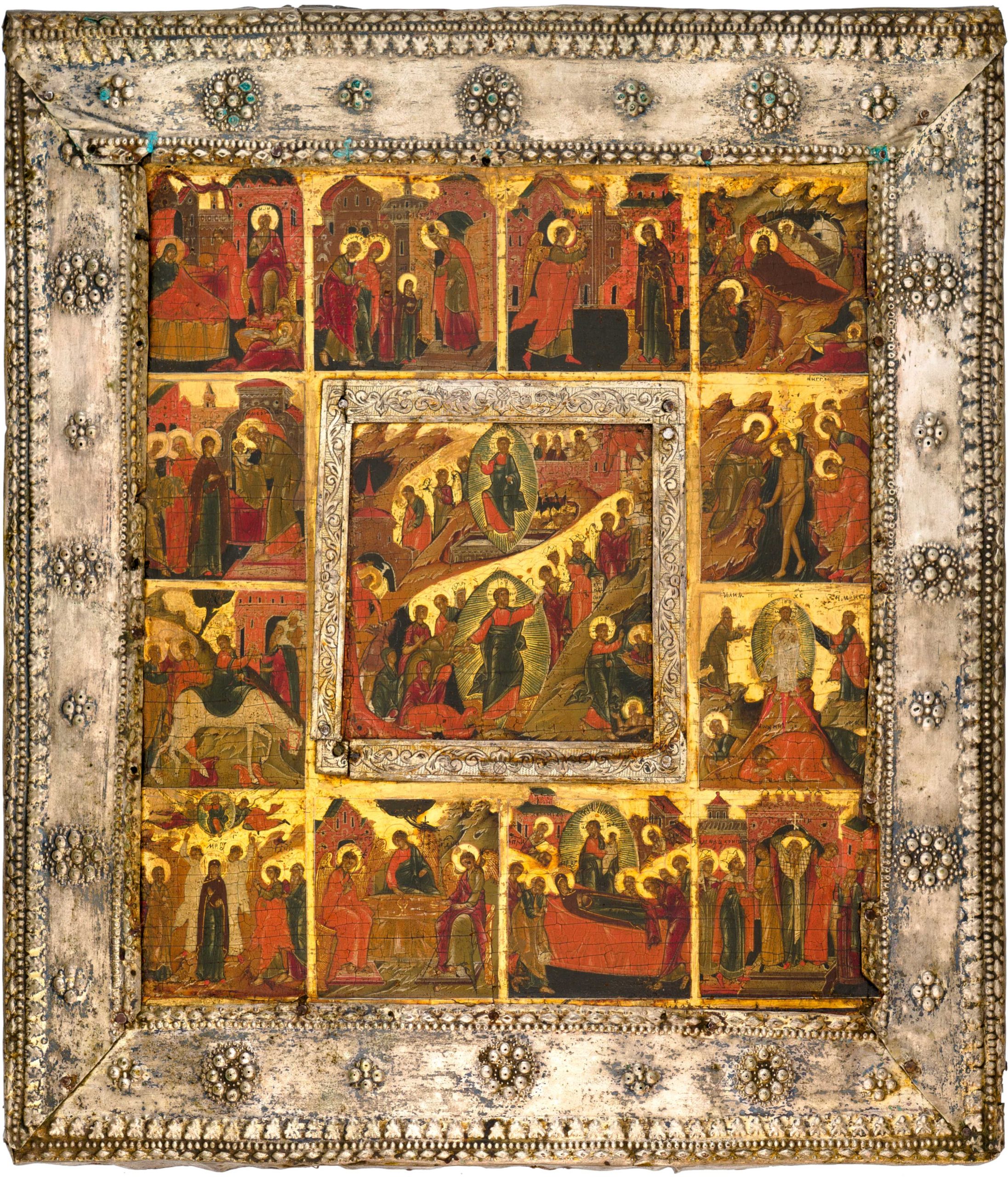
The Resurrection—the Descent into Hell, with Church Feasts in 12 Border Scenes. Icon: middle – second half of the 19th century. Mstyora (?). Oklad cover: end of the 17th century. The Oleg Kushnirskiy Collection.
Palekh and Mstyora Icons in Modern Collections
The legacy of Palekh and Mstyora icon painting survived the Russian Revolution of 1917. In 1924, Palekh icon painter Ivan Golikov founded the Artel of Ancient Painting, helping preserve traditional artistic techniques. Similar workshops soon appeared in Mstyora and Kholuy, allowing local masters to continue working despite dramatic political and cultural changes.
Many Old Believer icons later left the Soviet Union during state-sponsored sales of religious art and eventually entered museum and private collections abroad. One of the largest and most coherent private collections of Old Believer icons in the United States is the collection of Oleg Kushnirskiy. Featuring more than 60 antique icons presented in a detailed scholarly art catalog, it serves as an important resource for researchers, collectors, and anyone interested in the history of Russian icon painting.