
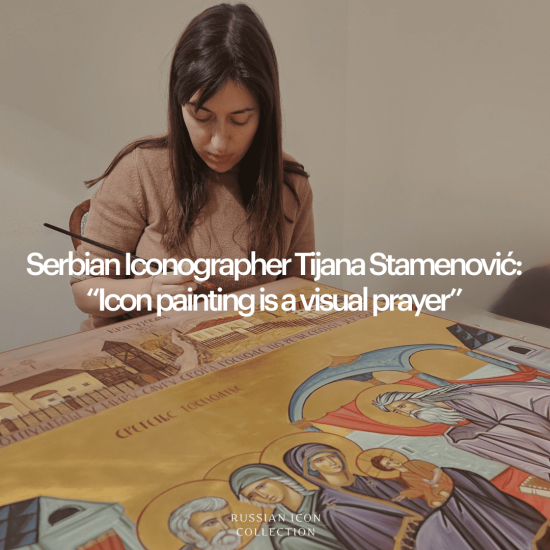
Serbian Iconographer Tijana Stamenović: “Icon painting is a visual prayer”
Tijana Stamenović has worked professionally as an iconographer since 2015 and holds a master’s degree in Church Arts–Wall Painting from the Academy of the Serbian Orthodox Church for Arts and Conservation in Belgrade. Her practice is rooted in the Serbian Orthodox tradition while engaging with the broader history of Byzantine and Orthodox art.
Over the past decade, she has created more than two hundred icons, presented her work in more than 50 group exhibitions and six solo exhibitions, and taken part in art colonies and international projects across Serbia and beyond. Her work is accompanied by research and writing on Orthodox art, including studies of miraculous icons and sanctuaries in the Holy Land.
In this interview, Tijana Stamenović talks about her path to iconography, the role of faith and tradition in her practice, and the place of the icon in contemporary art and spiritual life.
Your education combines law and fine art. How did this seemingly unusual combination lead you toward iconography?
My background in law and fine art may seem unusual, but these two fields actually come together perfectly in iconography. Historically, law itself was seen as an art form. In ancient times, the art of rhetoric and eloquent speech helped the best speakers win major legal disputes. Law wasn’t just about rules; it was about the power of expression. Fine art gave me the technical skills like color, composition, and precise brushwork. Law taught me to respect rules, structures, and deep symbolic meanings. Iconography is where these two worlds meet. It is a sacred visual language governed by strict theological rules and traditional canons—much like a legal framework. My legal background taught me to respect and interpret these strict boundaries, while my art background allowed me to express them with beauty. Ultimately, just as ancient lawyers used rhetoric to illuminate justice, an iconographer uses line and color to illuminate the divine.
What were you searching for personally when you first turned to icon painting? Has that search changed over the years?
When I first started, I was looking for a way to connect with the incredible beauty of sacred art. I was deeply drawn to the calm and holy faces on the icons and frescoes in our churches. The turning point for me was seeing the famous White Angel fresco at the Mileševa Monastery. Looking at it awakened a strong desire in me to learn how to paint like that. Over the years, that curiosity turned into a deep love. I started taking private classes, but my passion kept growing. I realized I wanted to study iconography on a much deeper level. That love is what finally led me to enroll in formal academic studies dedicated entirely to this sacred art.
Do you see iconography as a form of spiritual practice? What does painting an icon demand from you inwardly?
In fact, I see icon painting as a sacred act. It is not just about painting—it is a visual prayer. To truly paint an icon, you need to live an active life within the Church and have a deep knowledge of the Orthodox faith. You cannot separate the art from the spiritual life that created it.
Inwardly, painting an icon demands patience, humility, and complete focus. You have to quiet your mind and leave the noise of the world behind. Because it is a sacred act, you must put aside your own ego and respect the traditional canons. It requires you to grow spiritually so that the holy beauty of the saint can truly shine through your work.
Is there a particular icon or work from your early period that you still feel especially connected to? Why?
It is the icon of the Virgin Mary Eleusa, the very first icon I ever painted. I did not paint it completely on my own, but I worked on it with so much love. I was incredibly joyful to paint the two most important figures of my faith: the Virgin Mary and the Christ Child.
Near the end of the process, something remarkable happened. While opening a bottle of dark wood stain to finish the edges, I accidentally spilled it all over my desk. It splashed everywhere, even ruining the nearby walls, which I later had to repaint. Yet, beautifully, the painted image of the Mother and Child remained completely untouched. To this day, that icon hangs on my wall. For me, it was a quiet little miracle and a beautiful sign of grace that marked the very beginning of my journey.
What distinguishes the Serbian approach to iconography from the traditions of Greece, Russia, or other Orthodox countries? How much of what we call “Serbian iconography” is specifically Serbian, and how much belongs to a common Orthodox visual and theological language?
Serbian iconography shares the same theological language as Greece and Russia, but it has a very distinct spirit and style. The strict rules and meanings belong to the common Orthodox tradition. However, the way Serbian icons and frescoes were painted is unique. The 13th and 14th centuries were the golden age, making Serbia the center of church art in the region. You can still see this incredible beauty today in our finest monasteries across Serbia, Kosovo and Metohija, and North Macedonia.
For example, the frescoes of the Sopoćani Monastery are so full of life and harmony that art historians call them a “Renaissance before the Renaissance.” The Serbian tradition also thrived on sharing skills with others while staying completely true to the Orthodox faith. Under the reign of King Milutin, famous painters like Michael and Eutychios came from Thessaloniki to lead the court workshop. While they were traditionally thought to be brothers, recent research shows they were actually father and son. Together, this family of masters blended the high Byzantine style with local sensitivity. Ultimately, Serbian iconography uses the shared rules of the Orthodox Church, but it expresses them with a unique and beautiful local character.
You have presented at international conferences on sanctuaries and miraculous icons in the Holy Land, and you are the author of a book on the Holy Land and Jerusalem. How has your study of the Holy Land influenced the way you understand sacred space and sacred images?
My journeys to the Holy Land and the holy city of Jerusalem completely transformed how I understand both Scripture and Orthodox iconography. An ancient tradition says that when God created the world, He gave nine measures of beauty to Jerusalem and only one to the rest of the world. Walking through those sacred spaces made me realize that the entire Holy Land is like a living icon of the Gospel events. It brings the scriptures to life, deepening my love for our faith and the sacred images that represent it. The Holy Land is also home to deeply inspiring miraculous icons. My favorite is the Jerusalem Icon of the Mother of God (Panagia Ierosolymitissa), which rests at the Tomb of the Virgin Mary in Gethsemane. Its history is truly wonderful. In the 19th century, the Most Holy Theotokos appeared in a vision to a nun named Tatiana at the nearby Convent of St. Mary Magdalene. The Virgin Mary asked to be painted, and the icon was miraculously completed. For me, studying these sacred spaces proved that icons are not just paintings on wood. Тhey are windows into the divine, directly connected to the real places where God walked among us.
What have you learned from researching the history of miraculous icons?
Researching the history of miraculous icons taught me a beautiful truth: an icon is alive, and the saints are looking back at us. Through my studies, I realized that an icon is never just a passive object or a historical painting. It is a living presence. When we stand before a miraculous icon, we enter into a real relationship with the saint. The icon acts as a dynamic mirror where the spiritual world opens up to us. History shows that these icons are created through prayer and preserved by faith. Ultimately, they prove that the saints are not distant historical figures, they are alive, they hear our prayers, and they look upon us with love and grace.
Through your Lessons in Iconography project, you are also sharing knowledge with others. What do you feel is most important to pass on to a new generation of iconographers?
Through my project Lessons in Iconography, I want the readers of my texts to truly understand the essence and deeper meaning of the icon. It is important to know that iconography is a spiritual path, not just a technical skill. My goal is not to train people to be mere copyists or technically skilled painters. Instead, I want to inspire iconographers who truly believe in God and live their faith. While learning traditional techniques, colors, and line work is essential, technical mastery is empty without a spiritual foundation. I want readers to learn that to paint an icon, you must live the icon. This means grounding your work in an active life within the Church and approaching the canvas with prayer and deep humility. I want them to realize that their hands are merely instruments, allowing the living presence and holy beauty of the saint to shine through their work.
Do you think an icon can speak to someone who has little or no knowledge of Orthodox theology?
Yes, I absolutely believe an icon can speak to someone who knows nothing about theology, because icons speak through the universal language of beauty. Theology speaks to the mind, but an icon directly touches the human soul. An icon is not just a painting; it is a spiritual presence. When someone looks at a holy face, they do not need to understand complex rules or dogmas. They can immediately feel the deep sense of peace, love, and light coming from the saint’s eyes.
Is there a saint, biblical story, or iconographic subject that you return to repeatedly? What draws you to it?
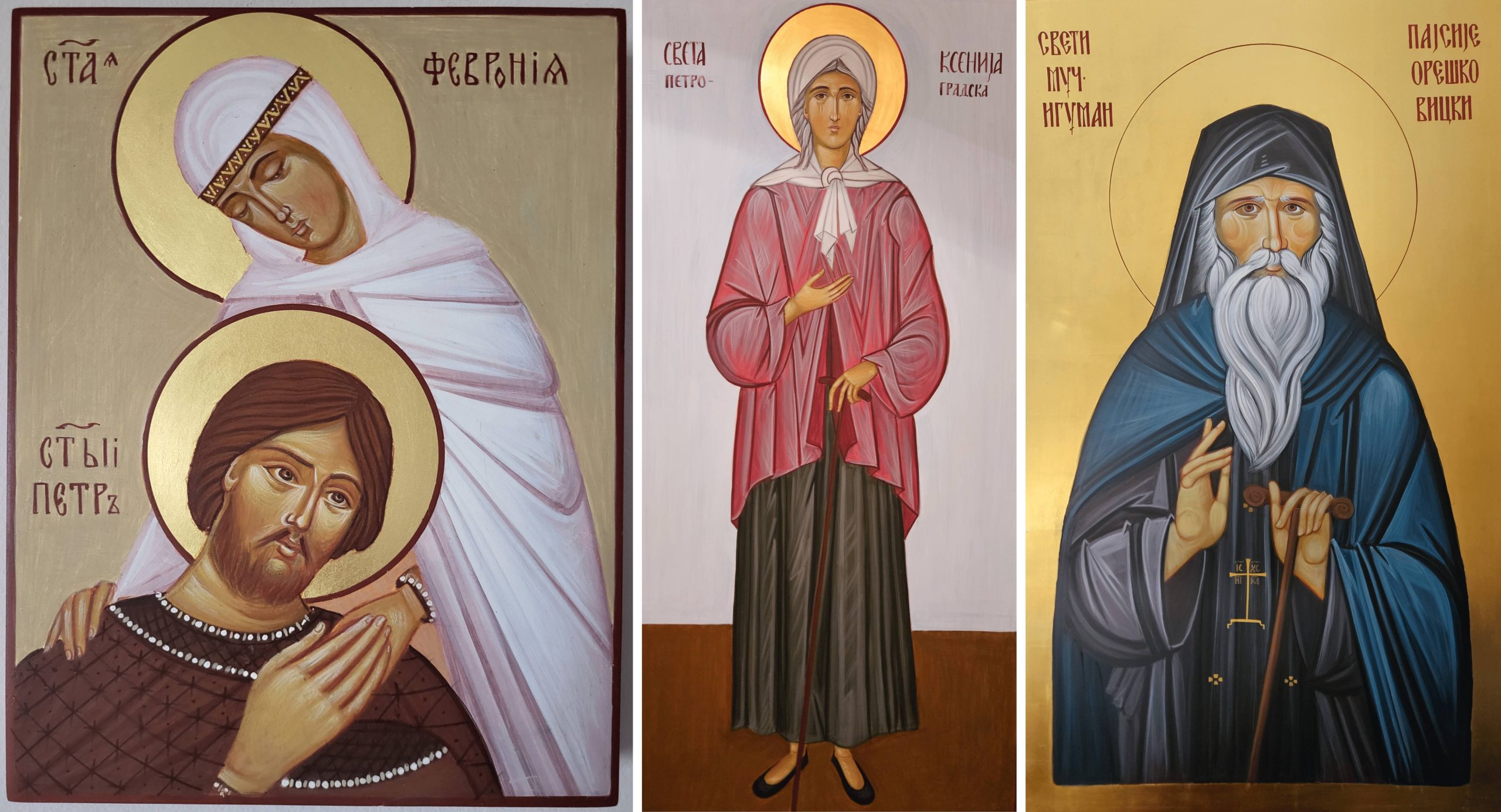
The iconographic subjects I return to repeatedly are the holy martyrs, both men and women, along with the sacred protectors of our history. Among the martyrs, I feel a very personal connection to Saint Theodore Tyro, as I was born on his feast day. However, the saint I have painted the most is Saint Catherine. I have a profound love for her because I was blessed to visit Mount Sinai and her holy monastery three times. Her hagiography—the story of her life, wisdom, and martyrdom—deeply moves me and brings a rich spiritual meaning to the creative process.
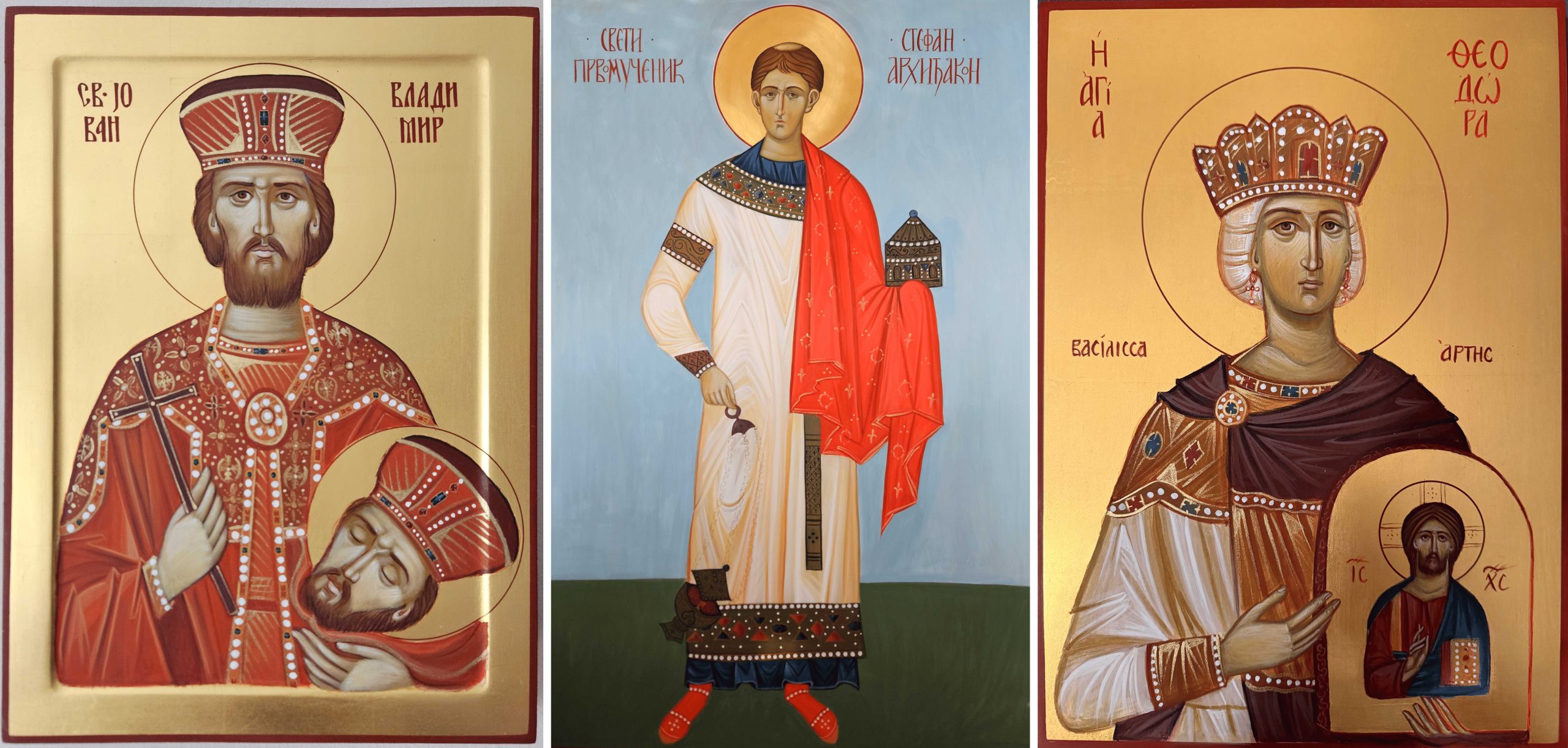
I also feel a strong connection to the historical guardians of our art. I love painting Saint Empress Theodora, who is revered as the historical protector of holy icons for ending the iconoclasm. I am also deeply drawn to Saint Luke the Evangelist, the very first iconographer, who painted the first images of the Mother of God.
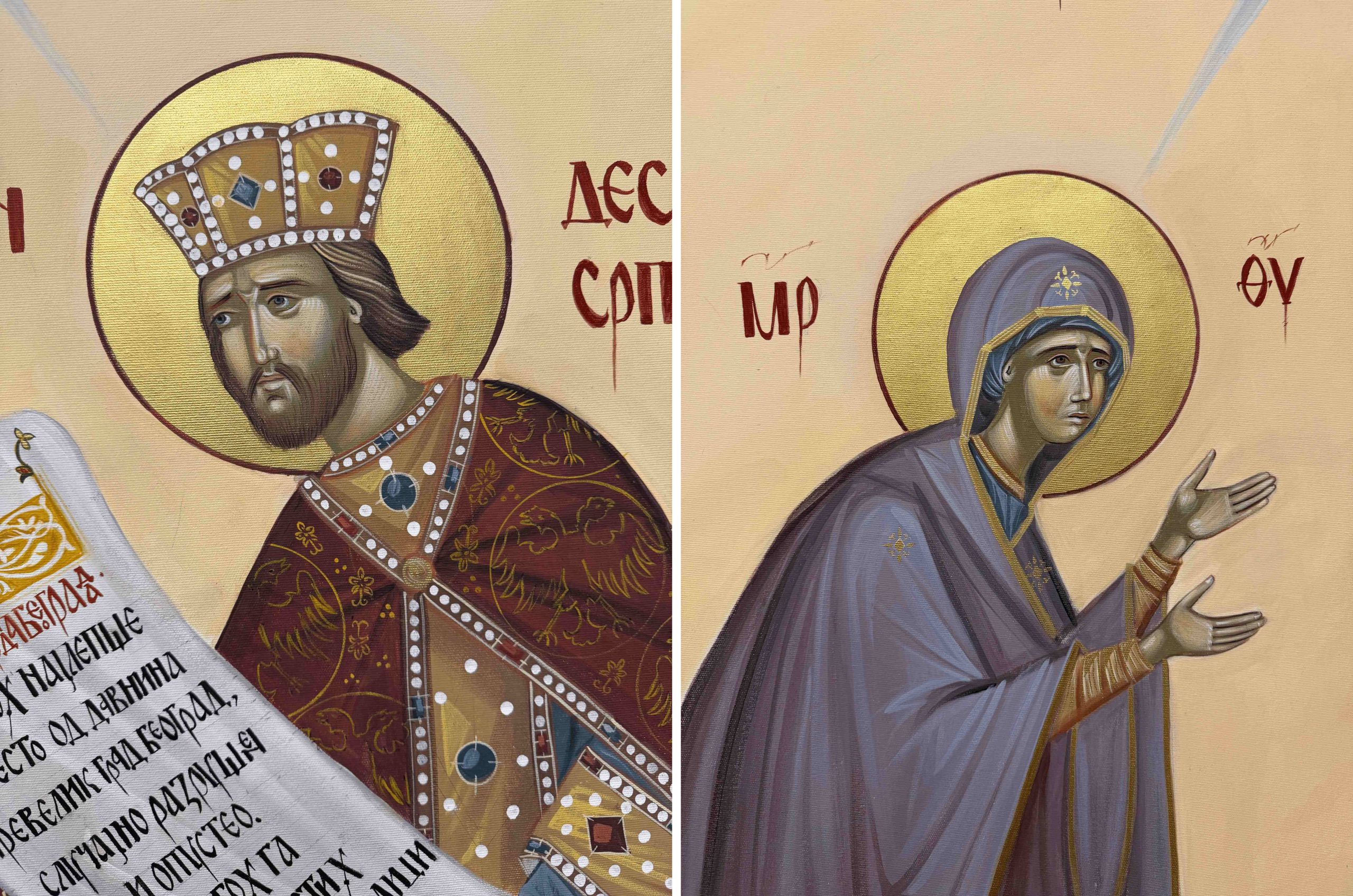
Additionally, I deeply love painting our holy Serbian rulers and martyrs, including Despot Stefan Lazarević, Saint Princess Milica, Saint Prince Lazar, Saint John Vladimir, Saint Deacon Avakum, and the holy Nemanjić dynasty. Every time I paint these holy faces, it reminds me that my hands are simply instruments meant to reveal the living presence of the saints to everyone who looks upon the icon.
Are there subjects you have not yet painted because you feel you are not ready for them?
Yes, I currently avoid painting complex miniatures with a large number of fine details, because they require a different kind of focus. Since I manage multiple professional responsibilities, my time is often limited. Because of this, I find that monumental compositions suit me much better.
You continue to consult with iconographers in Serbia, Israel, and Greece. How important is that dialogue with other practitioners to your development?
The dialogue with iconographers from Serbia, Israel, and Greece is incredibly important to me, as I am sharing knowledge with masters who have spent decades in this profession. There is always something profound to learn from their deep experience, technical insights, and spiritual wisdom. Among these connections, my relationship with the Jerusalem-based iconographer Gabriel Nalbandian is especially precious to me. He paints with immense, inspiring faith, and beautifully, some of the holy icons he has created have even manifested miracles.
Photos and artworks: © Tijana Stamenović