
The Meaning of Symbols in Russian Icons: Decoding the Sacred Language
Russian icons communicate through a carefully developed visual system in which colors, gestures, inscriptions, objects, and composition all contribute to the image’s symbolism. Understanding the meaning of symbols in Russian icons requires looking at the broader Byzantine tradition of iconography, which later developed into distinctive regional styles, including the Novgorod and Moscow icon schools.
Light and Space
Many elements in an icon serve a symbolic or theological purpose rather than simply decorating the image. A gold background, for example, is commonly understood as a reference to divine glory and uncreated light rather than a depiction of the sky. Figures generally do not cast naturalistic shadows, reinforcing the spiritual rather than earthly character of the scene.
Icon painters also used reverse perspective, in which the vanishing point appears to lie within the viewer. This creates an unusual sense of space that draws the viewer into the image rather than presenting a conventional three-dimensional world. Landscapes and architecture are often simplified into recognizable visual signs. Mountains, for instance, may appear as stepped forms, while buildings can be shown from multiple viewpoints.
Symbolism of Color
Color carries meaning in Orthodox iconography, although its interpretation depends on the subject and context. Gold is associated with divine glory, while white can suggest purity, heavenly light, and resurrection. Red may symbolize life, sacrifice, or martyrdom, while blue is often connected with heaven, revelation, or spiritual mystery. Green can evoke life, renewal, and the natural world.
These associations are not rigid rules applied identically to every icon. The meaning of a color can change depending on the figure, garment, surrounding colors, and subject of the composition.
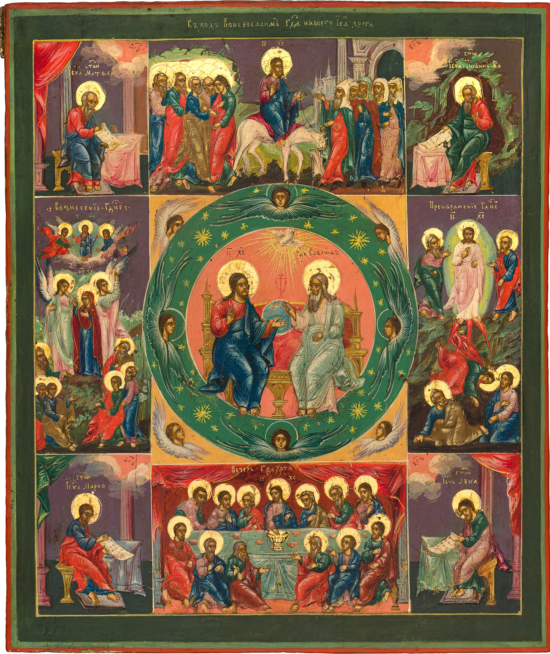
The New Testament Trinity, with Selected Church Feasts and the Four Evangelists. Early 19th century. Central Russia. The Oleg Kushnirskiy Collection.
Signs and Inscriptions in Icons
Inscriptions are essential to understanding who is depicted. Christ is commonly identified by the Greek abbreviation IC XC, while MP ΘY stands for “Mother of God.” Christ’s cruciform halo traditionally contains the letters Ο ΩΝ, meaning “He Who Is.”
Gestures and attributes provide additional clues. Jesus and certain saints may use a blessing gesture in which the fingers form the letters of Christ’s name. Saints can often be recognized by their attributes: Peter is associated with keys, prophets with scrolls, and evangelists with the Gospel.
The Meaning of Symbols in Russian Icons of Old Believers
Old Believer iconography preserved many pre-reform Russian traditions following the church reforms associated with Patriarch Nikon in the mid-17th century. Among the features associated with Old Believer art are the two-fingered blessing gesture and the spelling “Isus” (Iсусъ) rather than the post-reform “Iisus”. Old Believers also traditionally favored the eight-pointed cross, an important feature of pre-reform Russian religious practice.
For readers interested in exploring this tradition further, the Oleg Kushnirskiy catalog of Russian icons offers additional historical material, expert commentary, and examples of Old Believer icons.