
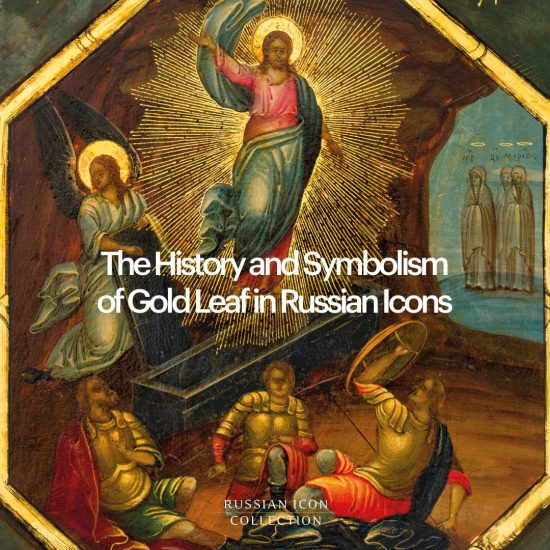
The History and Symbolism of Gold Leaf in Russian Icons
The use of gold leaf in Russian icons has historically been about much more than decoration. Icon painters used gold as an important visual element to express religious ideas and the presence of divine light. In Russian icon painting, gold was closely associated with “svet,” or “light.” The golden surface of an icon could evoke the idea of divine and eternal light and was connected with the Christian symbolism of light, truth, and glory.
The choice of gold was not accidental. Its highly reflective surface gives the icon a luminous quality and contributes to the distinctive visual effect of gilded backgrounds. In the Byzantine and Russian traditions, the shimmering appearance of gold was closely connected with its symbolic meaning as an image of light, truth, and glory.
How Did Icon Painters Apply Gold Leaf in Russian Icons?
The use of gold in Russian icons was rooted in Byzantine artistic traditions and developed within the various traditions of Russian icon painting, including Novgorod, and Moscow schools. Traditionally, icons were painted on wooden panels, often covered with a linen or other textile layer known as “pavoloka.” Then the icon surface was prepared with a ground known as “levkas.”
The gold leaf was applied to the prepared surface using a suitable adhesive. In Russian icon painting, the gold used for gilding was commonly “susal’noe” (leaf) gold, made by hammering precious metal into extremely thin sheets. Gold was often applied to the icon’s background and then polished, making the joins between overlapping sheets less visible. A colored ground could be placed beneath the gold, including a reddish-brown bole known as “polyment,” although such a preparation was not always necessary in Byzantine and early Russian icon painting.
Gold could also be further decorated after application. Icon painters used techniques such as “tsirovka” (incised ornament) and “kanfarenie” (ornamental punching) on gilded levkas, creating patterns and textures that enhanced the surface of the icon.
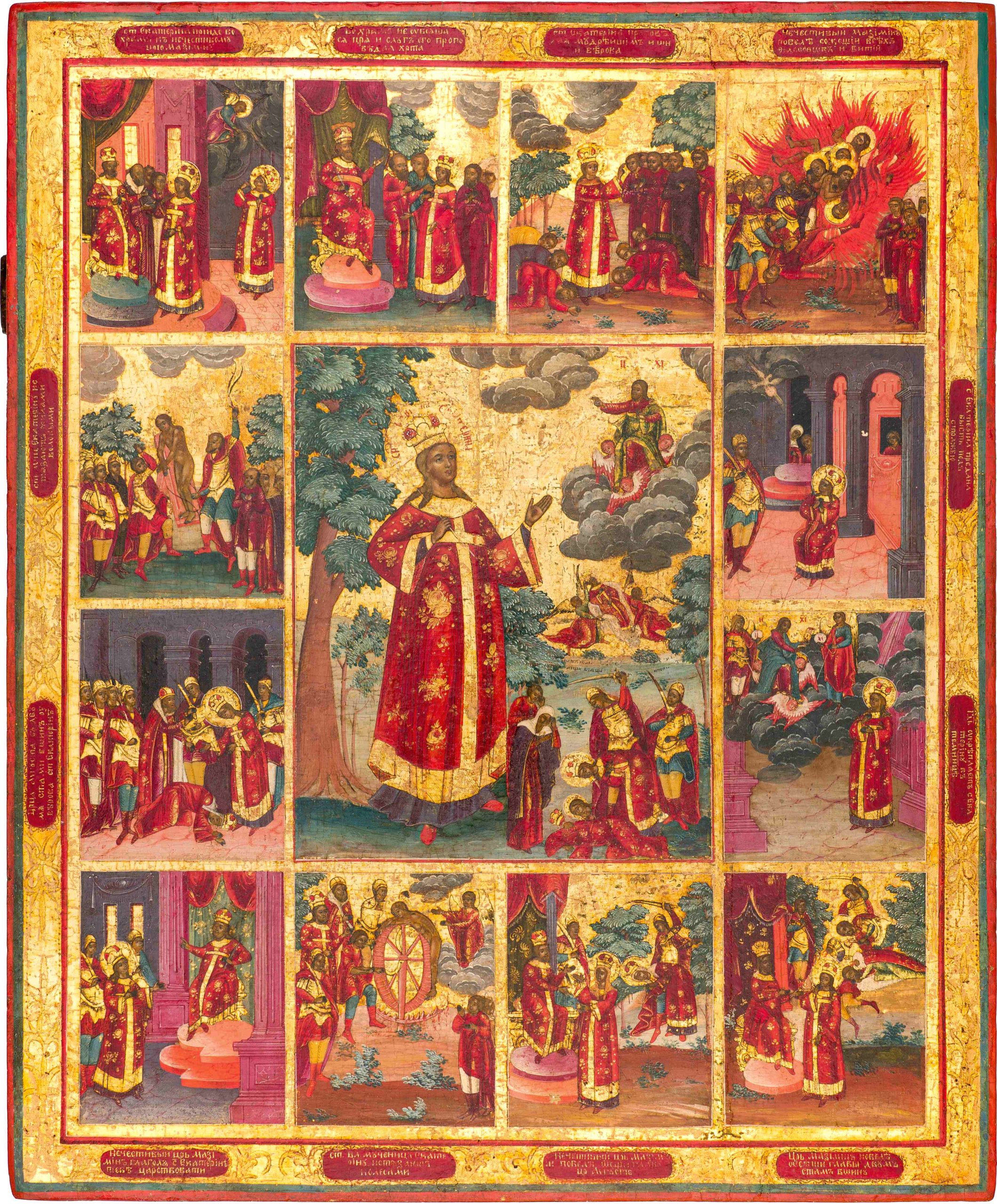
The Great Martyr Catherine, with 12 Hagiographical Border Scenes. Second quarter of the 19th century. Vetka. Wood (two panels), two incut smooth support boards, absence of an incut centerpiece, underlying layer of canvas not visible, tempera, colored lacquers, gilding, engraving over gold, embossing over the gesso. The Oleg Kushnirskiy Collection.
Gold Leaf in Old Believer Icons
The schism of the mid-17th century gave rise to the Old Believer movement. Old Believer communities preserved many elements of earlier Russian religious and artistic traditions, including pre-reformian approaches to icon painting.
As can be seen in the icon catalog of the Oleg Kushnirskiy collection, Old Believer icon painters continued to use ancient techniques of iconography and gilding. For example, the icon-painting tradition of Vetka included the use of pavoloka, levkas, gilding, incised decoration, and gold leaf. These traditions could coexist with local artistic features and new iconographic developments.
Over the centuries, different Russian icon-painting centers developed their own approaches to gilding and surface decoration. Regional traditions can be distinguished by their techniques, decorative details, and treatment of gold. These features can help art historians and specialists identify an icon’s artistic tradition, region, and period. Over the centuries, different Russian artistic centers developed their own approaches to gilding and surface decoration. Regional differences can be seen in the techniques and decorative details used on icons and their precious-metal coverings. These features can provide art historians and specialists with important clues about an icon’s school and period.