
Russian Icon Painting: Old Believer Techniques and Traditions
Old Believers played an important role in preserving traditional Russian icon painting after the reforms of Patriarch Nikon in the 1650s. Rejecting the new rites, Old Believer communities continued to follow pre-reform religious and artistic traditions. Ancient icons and their established iconographic models remained highly valued, and new icons were often created according to older examples.
The Traditional Russian Icon Painting Technique
Old Believer icon painters continued many traditional methods of icon production. The icon was painted on a wooden panel, often with a recessed central field called a kovcheg. A linen cloth (pavoloka) was attached to the wood and covered with levkas, a white ground traditionally made from chalk and animal glue. The surface was carefully polished to create a smooth foundation for painting.
The image was outlined on the prepared ground, while gold leaf was applied to halos and, depending on the composition, the background. The image itself was traditionally painted with egg tempera. Artists built up colors in successive layers, using darker tones and gradually adding lighter highlights to define faces, garments, and other details. The finished icon was traditionally covered with olifa, an oil-based protective coating. These techniques remained central to traditional Russian icon painting and were also preserved in Old Believer workshops.
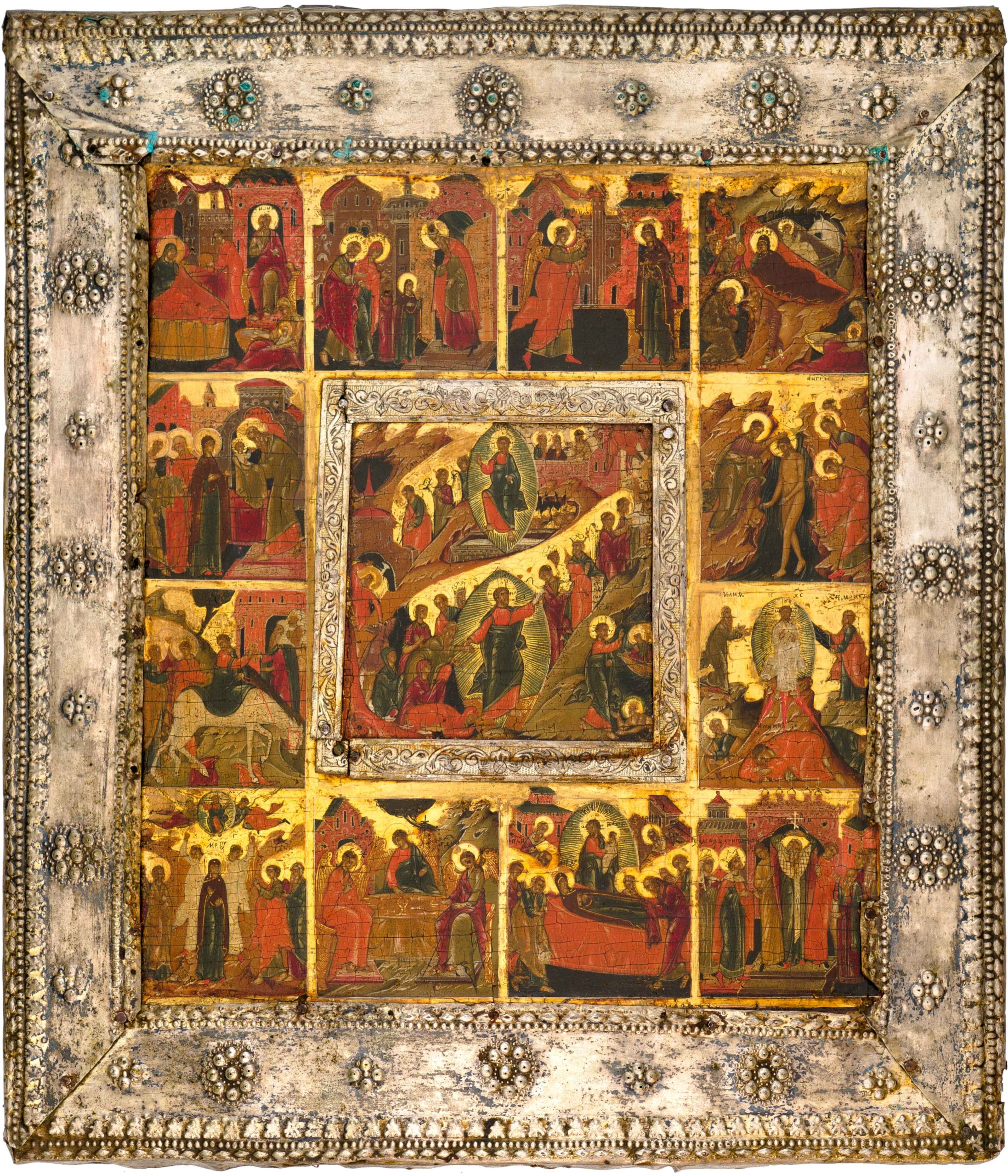
An example of an artificially aged icon from Oleg Kushnirsky’s collection. The artist used a traditional composition and subdued tones, applying an artificial craquelure to the surface and framing the icon in an old frame. The Resurrection—the Descent into Hell, with Church Feasts in 12 Border Scenes. Icon: middle to the second half of the nineteenth century. Possibly Mstyora. Oklad cover: end of the seventeenth century.
The Beauty of a Dark Surface
Over time, olifa can darken and yellow, changing the appearance of an icon. Smoke from candles and oil lamps, dust, and repeated exposure to ritual use could further affect the surface. As a result, older icons may develop a distinctly dark, brownish appearance.
For artists working in the traditionalist style in the late 18th and 19th centuries, the visual language of ancient Russian icons became an important source of inspiration. Old Believer patrons particularly valued archaic-looking images, and icon painters in centers such as Palekh and Mstyora developed styles that deliberately referred to earlier models. They not only replicated older techniques, styles, and iconography, but often intentionally aged the icons: they used old wood and dark paints, imitated darkened olifa, applied artificial damage to the surface, and used black paint to simulate cracks in the paint layer.
Reading an Old Believer Icon Collection
An Old Believer icon is more than a religious image frozen in time. Its materials, techniques, iconography, and stylistic choices can reveal how earlier traditions were preserved and reinterpreted across generations. The Old Believer icons in the Oleg Kushnirskiy Collection, presented in the illustrated icon catalog, offer a closer look at this distinctive chapter in the history of Russian icon painting.