
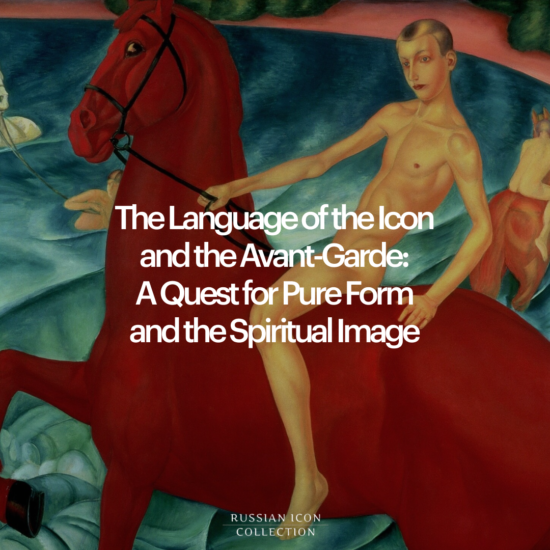
The Language of the Icon and the Avant-Garde: A Quest for Pure Form and the Spiritual Image
While not so obvious at first glance, the language of the icon and the avant-garde has lots in common. Both Russian icons and the early 20th-century avant-garde movement share a denial of realism, creative use of flatness, symbolism of colors, reverse perspective, and form deformation. This article explores the key terminology of icon painting and its reinterpretations by notable avant-garde artists like Kazimir Malevich and Natalia Goncharova.
The Language of the Icon and the Avant-Garde: Key Terms
The first notable similarity is the non-use of perspective in favor of flatness. This signature feature is observed in Russian icons across history, with reverse perspective intentionally used to create a spiritual space. The avant-garde and its sub-movements – Cubism and Suprematism – also dropped linear perspective to experiment with flat composition.
Color plays a symbolic role instead of a realistic reflection of subject properties in both religious and avant-garde art. Modern artists appreciated the broadness of color use for the sake of depicting emotional and spiritual tension without sticking to the realistic colors of their subject matter.
Another common aspect is the use of deformed shapes in icon painting and the avant-garde. Icon painters altered proportions to render sacral meaning over the realistic depiction of characters and events, while avant-garde painters used deformation in a quest for new expressive means.
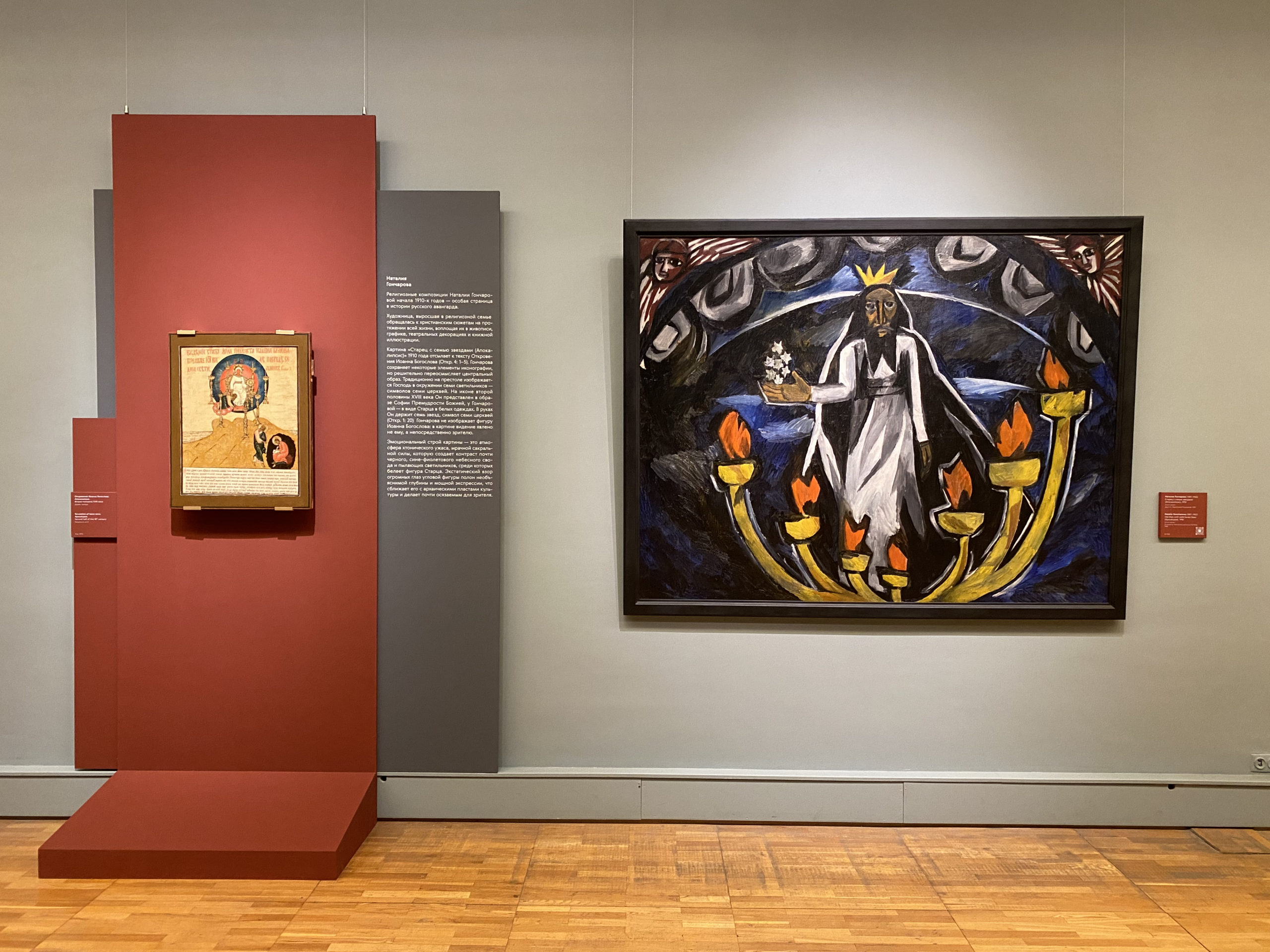
The exhibition The Avant-Garde and the Icon at the State Tretyakov Gallery. Photo: Igor Volkov.
In many ways, it is precisely through such parallels with Russian iconography that the avant-garde reveals itself as a unique form of new religious art. For instance, Kazimir Malevich’s Suprematism may be regarded as a new art religion, with paintings serving as new icons. Malevich equated Suprematism with the icon as a type of image free from imitation of nature. He rejected representationalism, thereby establishing the image’s frontal, two-dimensional nature. In his works, color and form function as independent elements that express a “pure sensation” rather than depicting the external world.
The work of Natalia Goncharova has also made a vital contribution to linking icons and avant-garde art: frontality and stillness, sign-character properties of gesture and pose, and the unique icon-like rhythm of sharp contours testify to the transfer of iconographic experience into modernist painting.
A New Glance at Religious Art Through the Eyes of Avant-Garde Artists
The common language of the icon and the avant-garde shows how 20th-century painters managed to transform fine art into a new icon form. While religious art relates to Orthodox worship, and the avant-garde is a revolutionary art movement, their commonalities are too stark to ignore. First and foremost, it is the pursuit of pure form and the depiction of the transcendental, which is characteristic of both of these movements.