
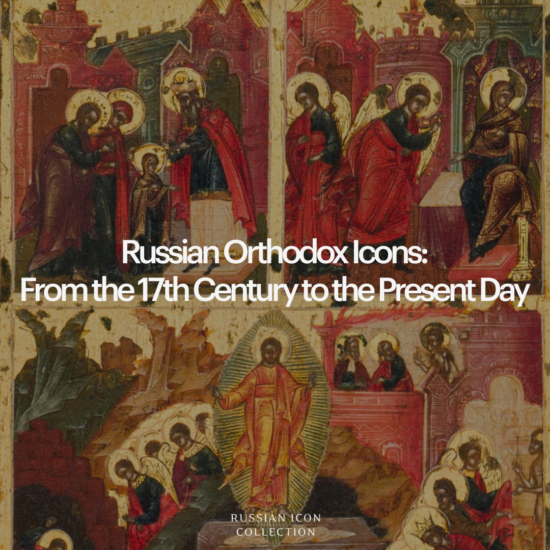
Russian Orthodox Icons: From the 17th Century to the Present Day
Oleg Kushnirskiy’s collection of icons is not a static ensemble but a living narrative of artistic transformation. Through insightful chronological perspective of Dr. Wendy Salmond, Professor at Chapman University, we see how Russian Orthodox icons evolved across centuries—from the 17th century to contemporary interpretations. This journey reveals a complex history shaped by faith, cultural exchange, and shifting artistic values.
The Old Believer Beginning
The story of the Oleg Kushnirskiy collection begins with one of its earliest pieces: a 17th-century icon of the Crucifixion surrounded by 16 border scenes. Beyond its devotional role, this work reflects the identity and resilience of the Old Believer community, which resisted Patriarch Nikon’s reforms and preserved pre-reform iconographic traditions and techniques.
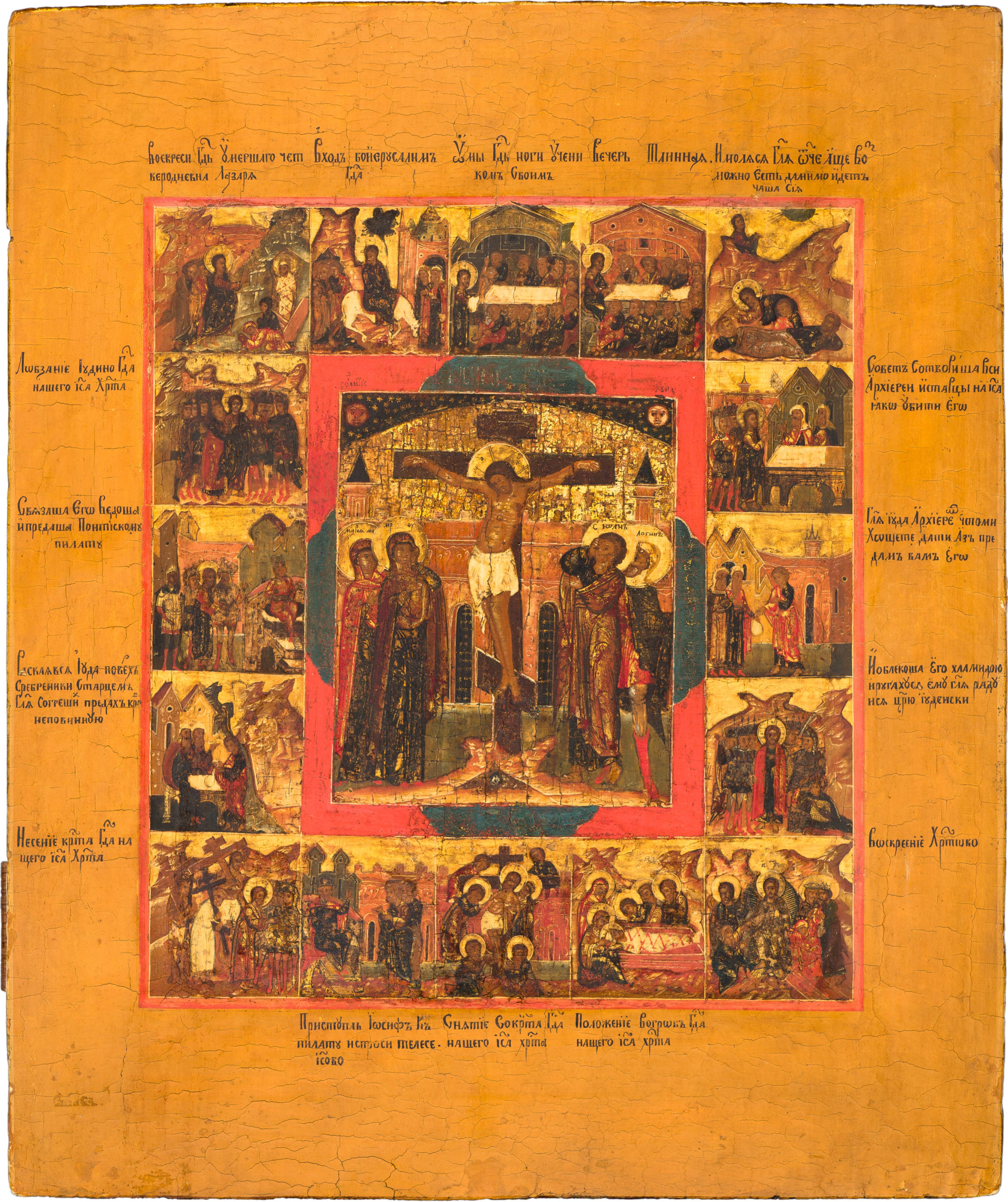
The Crucifixion, with the Passions of Christ and Church Feasts in 16 Border Scenes. Сenterpiece: around the middle of the seventeenth century. The Volga region (possibly Yaroslavl). Borders: nineteenth-century antique restoration.
Baroque Influences of the 18th Century
The 18th century was marked by profound Western influences on Russian Orthodox icons, with icon painters borrowing from European engravings and introducing new compositional schemes. One can see the recurring Catholic-style image of Christ Rising from the Tomb in the icons of that period, which coexisted with or replaced the traditional Orthodox imagery of Jesus Christ’s Descent into Hell. This was a period of the rise of many icon painting workshops across the Vladimir region, with Palekh, Mstyora, and Kholuy acquiring international significance.
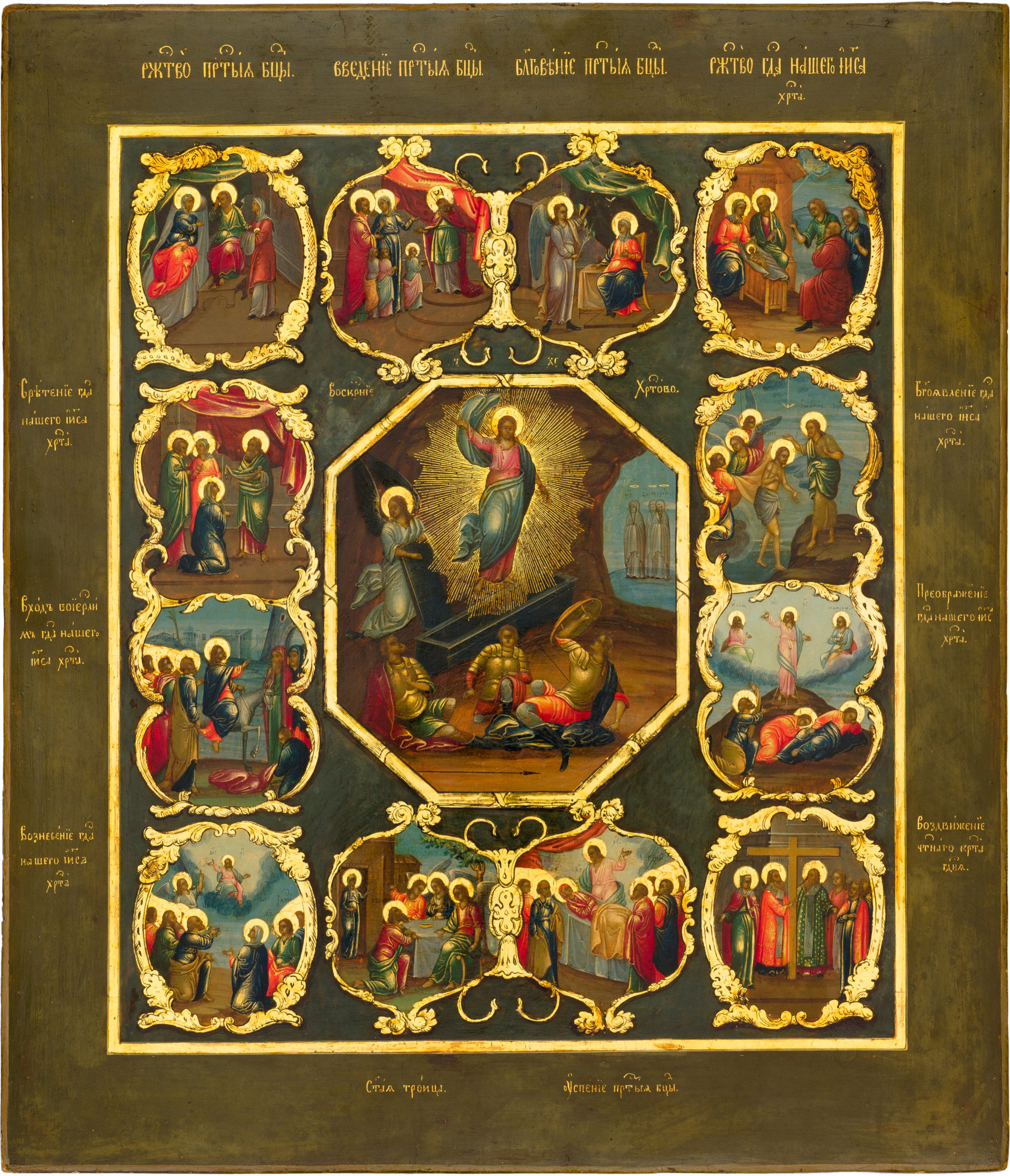
The Resurrection, with Church Feasts in 12 Border Scenes. Second quarter of the nineteenth century. St. Petersburg or Moscow.
Mass Production of Russian Orthodox Icons
The 19th century marked a peak in icon production. Characterized by refined color palettes and balanced compositions, this era saw both widespread dissemination and increasing standardization, which Dr. Wendy Salmond nonetheless doesn’t associate with a decline. Instead, this process reflects the growing accessibility of Russian icons, as well as the flourishing diversity of decorative elements such as oklads and stylistic variations.
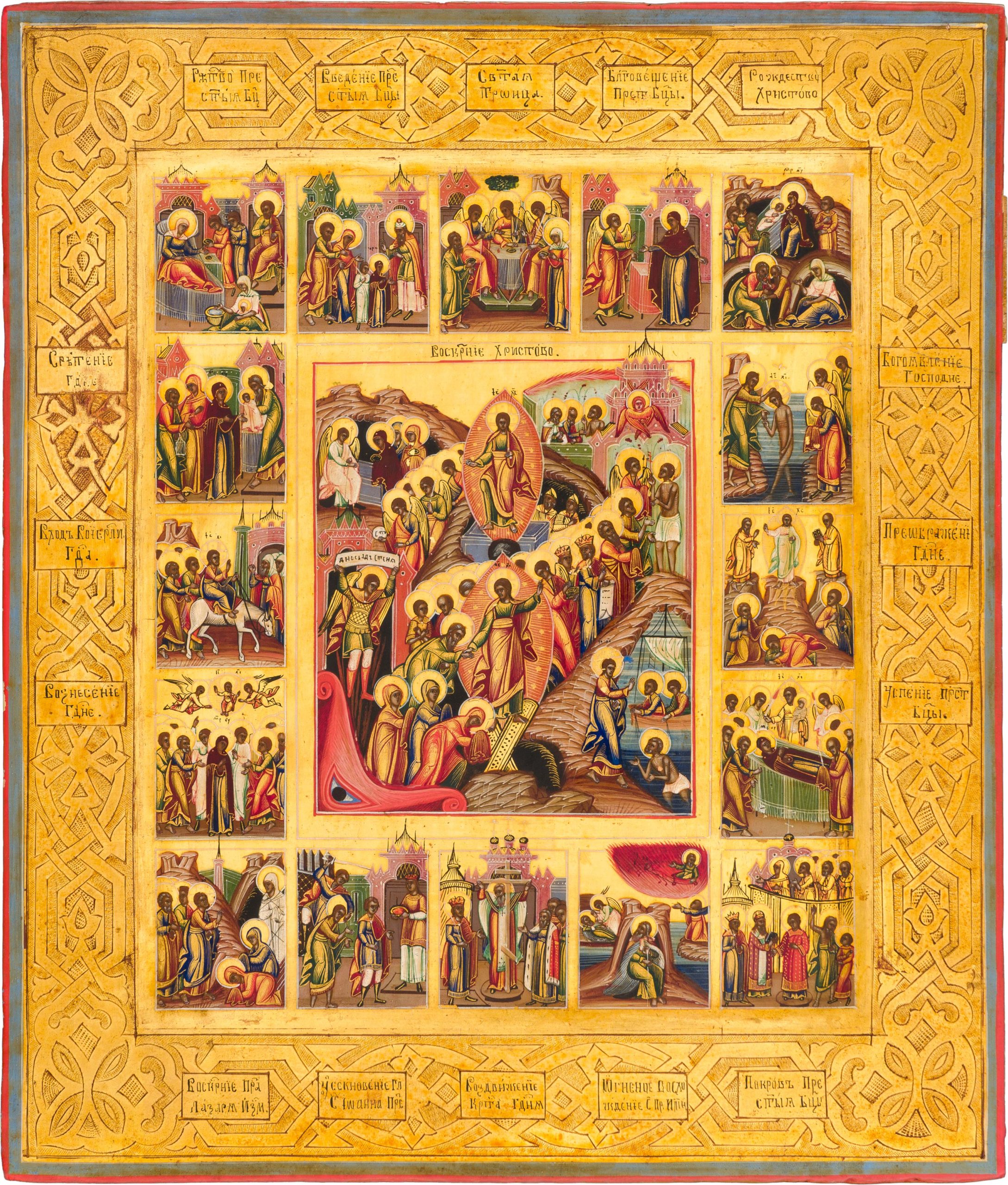
The Resurrection—the Descent into Hell, with Church Feasts in 16 Border Scenes. End of the nineteenth century. Mstyora.
Modernist Concept and Cultural Loss
By the early 20th century, perceptions shifted. Many critics began to view later icon traditions—particularly those of the 17th to 19th centuries—as derivative compared to medieval masterpieces. Early collectors like Ilya Ostroukhov focused on older works, contributing to the neglect of more recent iconography.
This reassessment, followed by Soviet anti-religious campaigns, led to widespread loss and destruction. For decades, Russian icons from vast historical periods were abandoned or forgotten. Only toward the end of the Soviet era, with renewed scholarly interest and the global dispersion of Russian communities, did efforts to rediscover and preserve this tradition gain momentum once again.
Learn more about the story of Russian Orthodox icons in the art catalog of the Oleg Kushnirskiy collection, which you can buy online on our website.