
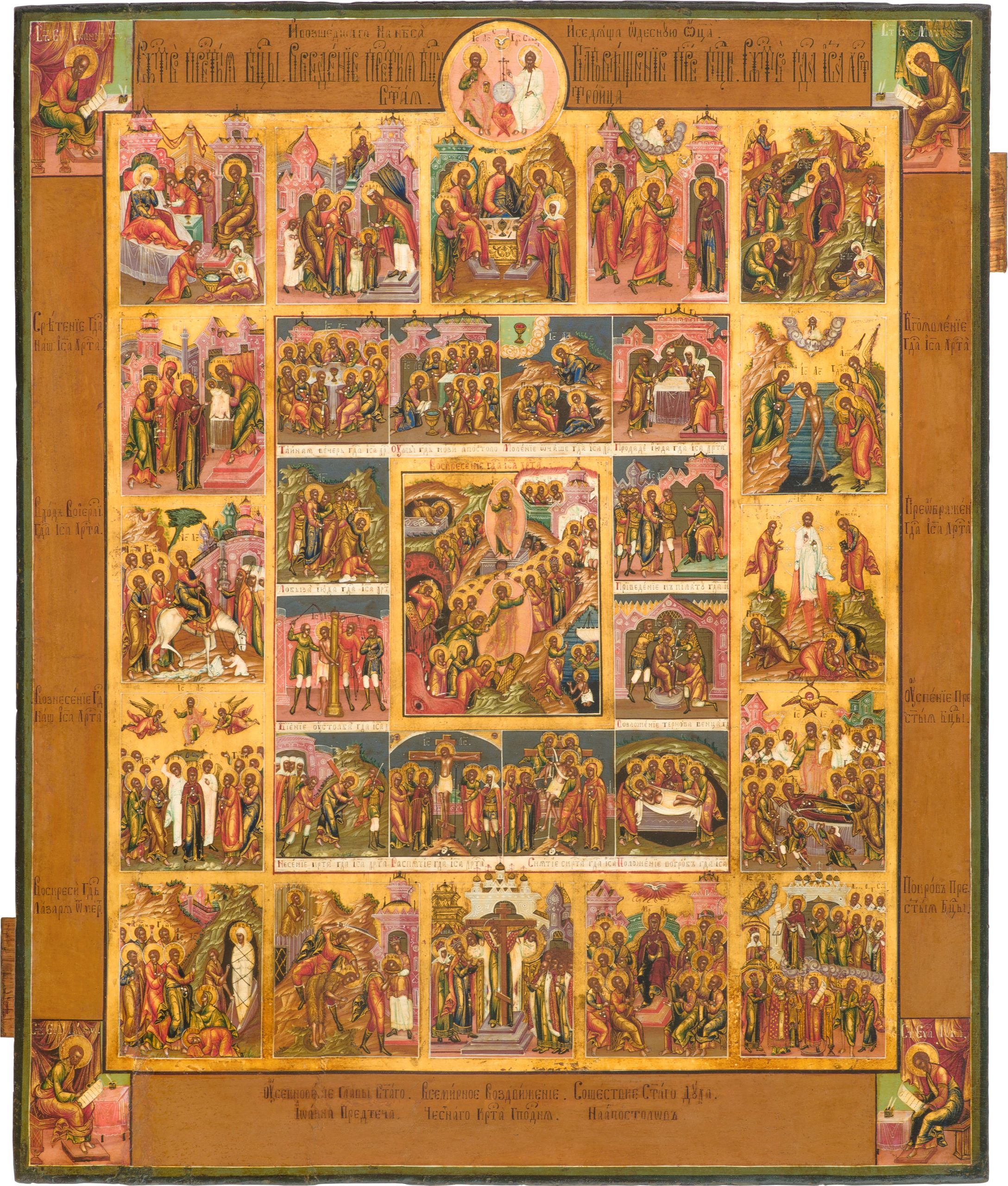
The Resurrection—the Descent into Hell, with the Passions of Christ and Church Feasts in 28 Border Scenes, the New Testament Trinity, and the Four Evangelists
Icon: middle to third quarter of the nineteenth century. Palekh.
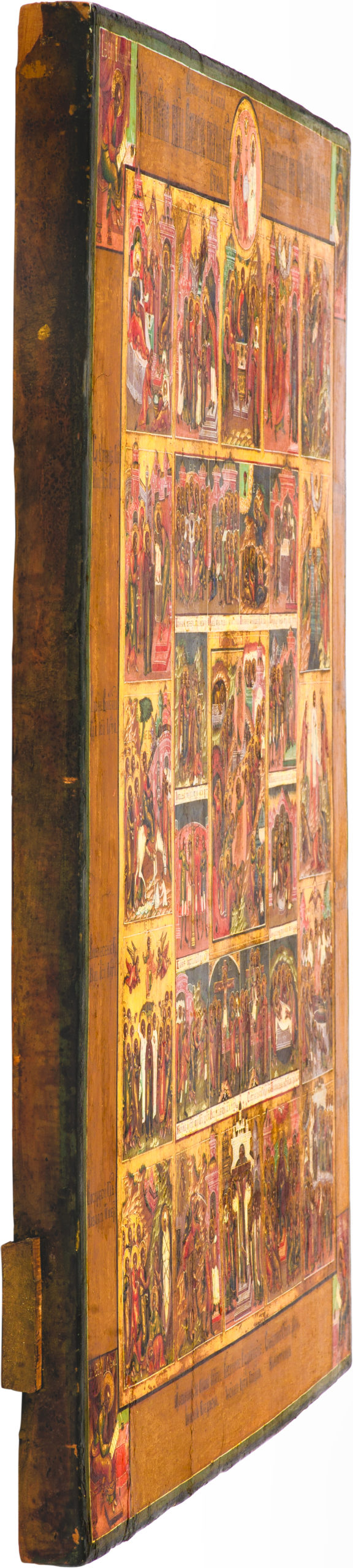
Size: 54 x 45 x 3 cm
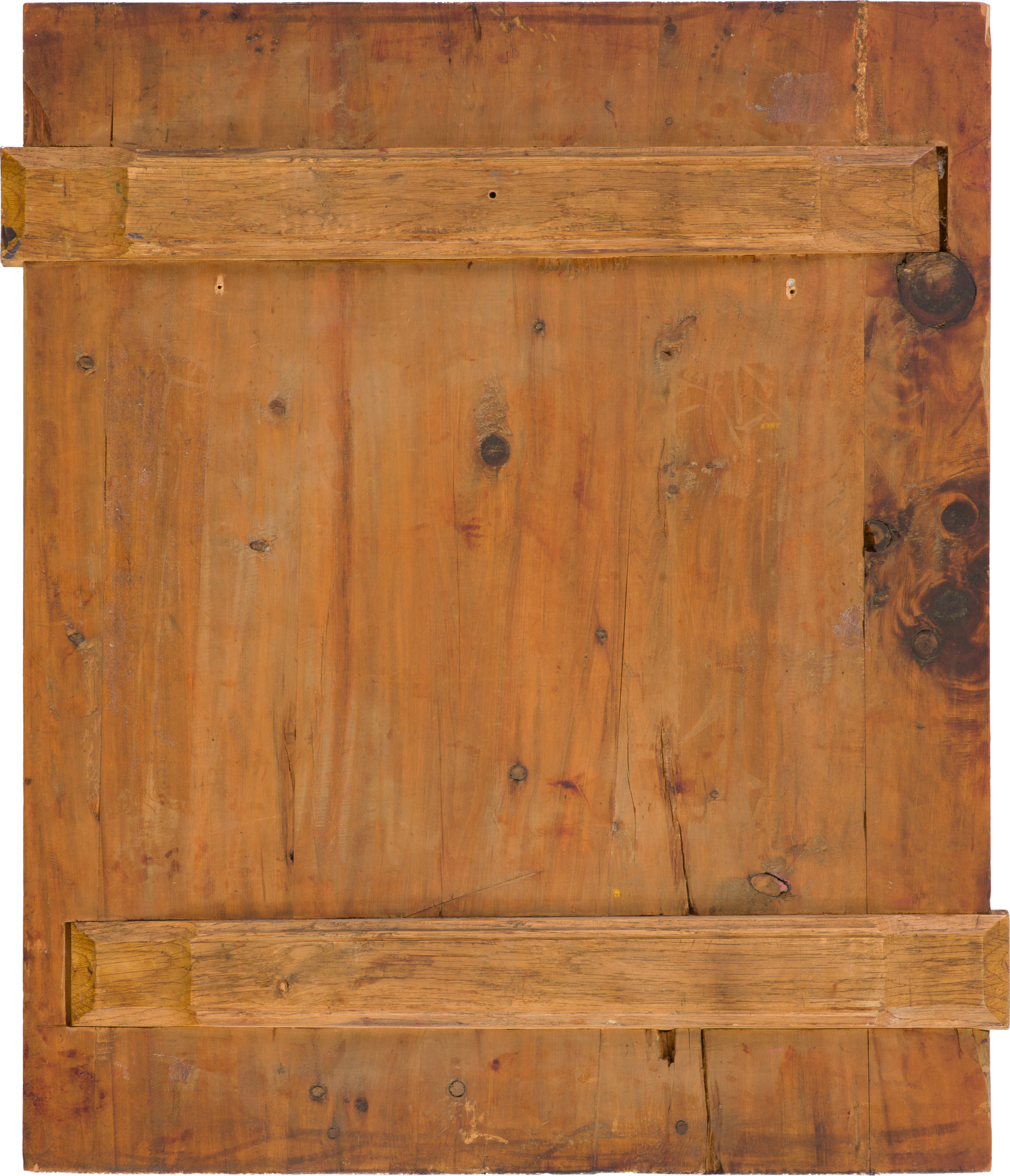
Wood (one whole panel), two incut support boards, absence of an incut centerpiece, underlying layer of canvas is probable, gesso, tempera, gilding.
The author’s paintwork is generally well preserved. The cracks in the base have been restored and retouched.
Diagram of the border scenes:
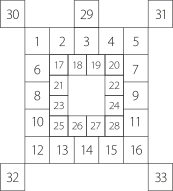
The Festive Cycle:
- The Nativity of the Mother of God;
- The Entrance of the Mother of God into the Temple;
- The Old Testament Trinity;
- The Annunciation;
- The Nativity of Christ;
- Candlemas (The Meeting of Christ in the Temple);
- The Theophany;
- The Entrance into Jerusalem;
- The Transfiguration;
- The Ascension;
- The Dormition of the Mother of God;
- The Raising of Lazarus;
- The Beheading of John the Baptist;
- The Elevation of the Holy Cross;
- Pentecost (The Descent of the Holy Spirit on the Apostles);
- The Pokrov (Feast of the Protective Veil of the Mother of God).
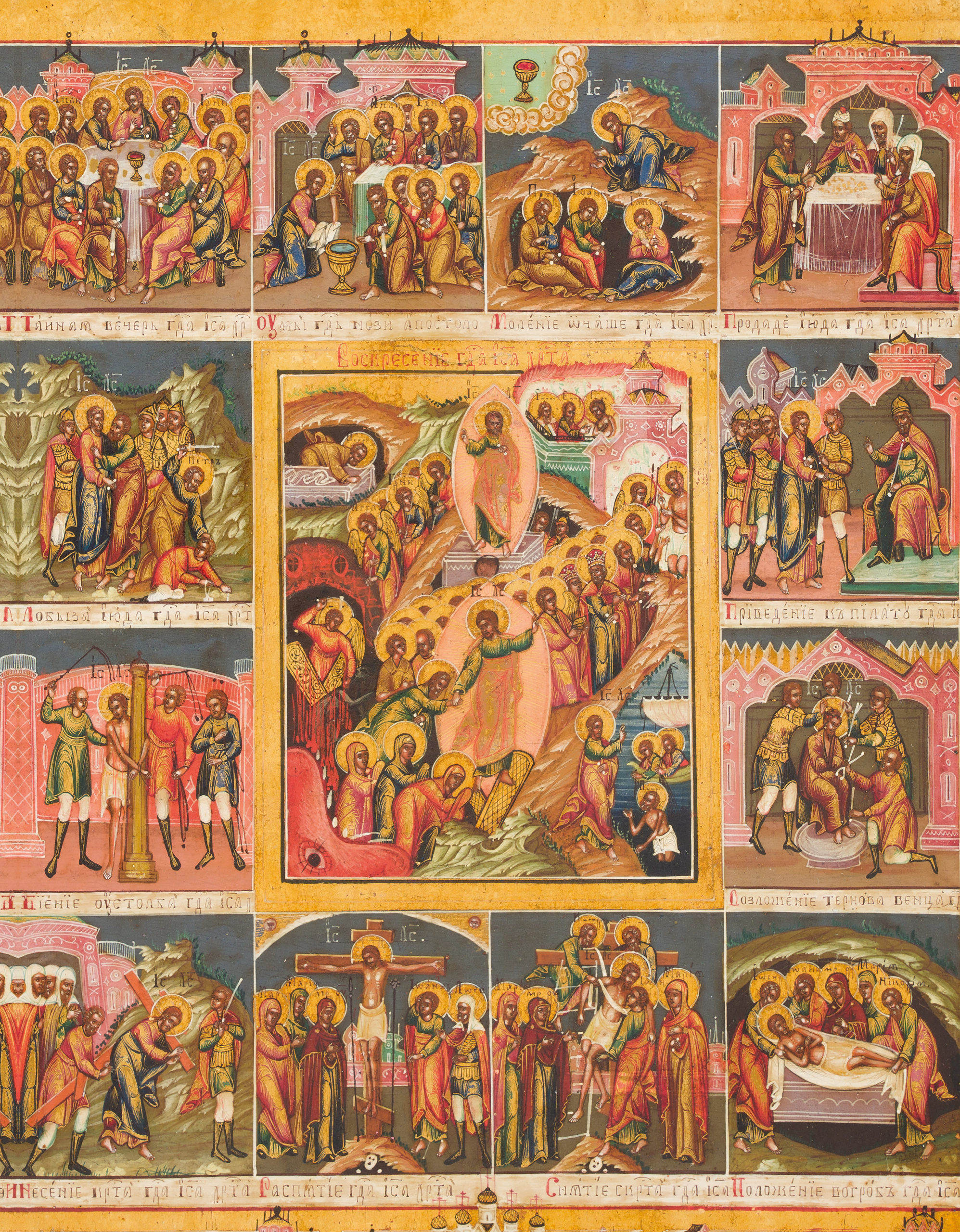
The Passion Cycle:
- The Last Supper;
- The Washing of the Feet;
- The Prayer in the Garden of Gethsemane;
- Judas Receives the Thirty Pieces of Silver;
- The Betrayal of Judas;
- Christ Before Pilate;
- The Flagellation of Christ;
- The Crown of Thorns;
- The Carrying of the Cross;
- The Crucifixion;
- The Descent from the Cross;
- The Entombment;
- The New Testament Trinity (The Enthronement);
- The Evangelist John the Theologian;
- The Evangelist Matthew;
- The Evangelist Mark;
- The Evangelist Luke.
The Resurrection—the Descent into Hell, with the Twelve Great Church Feasts, was a central iconographic scheme in Vladimir villages, especially Palekh. Christ is depicted rising from the tomb and descending into Hell, forming a central axis around which the composition is organized. The icon also includes Christ’s revelation to the Apostles, emphasizing His mercy and the promise of heavenly life.
The centerpiece is framed by cycles of feasts and the Passions, with Evangelists in the corners and Soprestolie (Enthronement) at the top, paralleling the Old and New Testament Trinities. Palekh style is evident in pink shades, steep whitewashed hills, refined architecture, detailed faces, and gilded draperies, dating the icon to the mid- to late nineteenth century.