
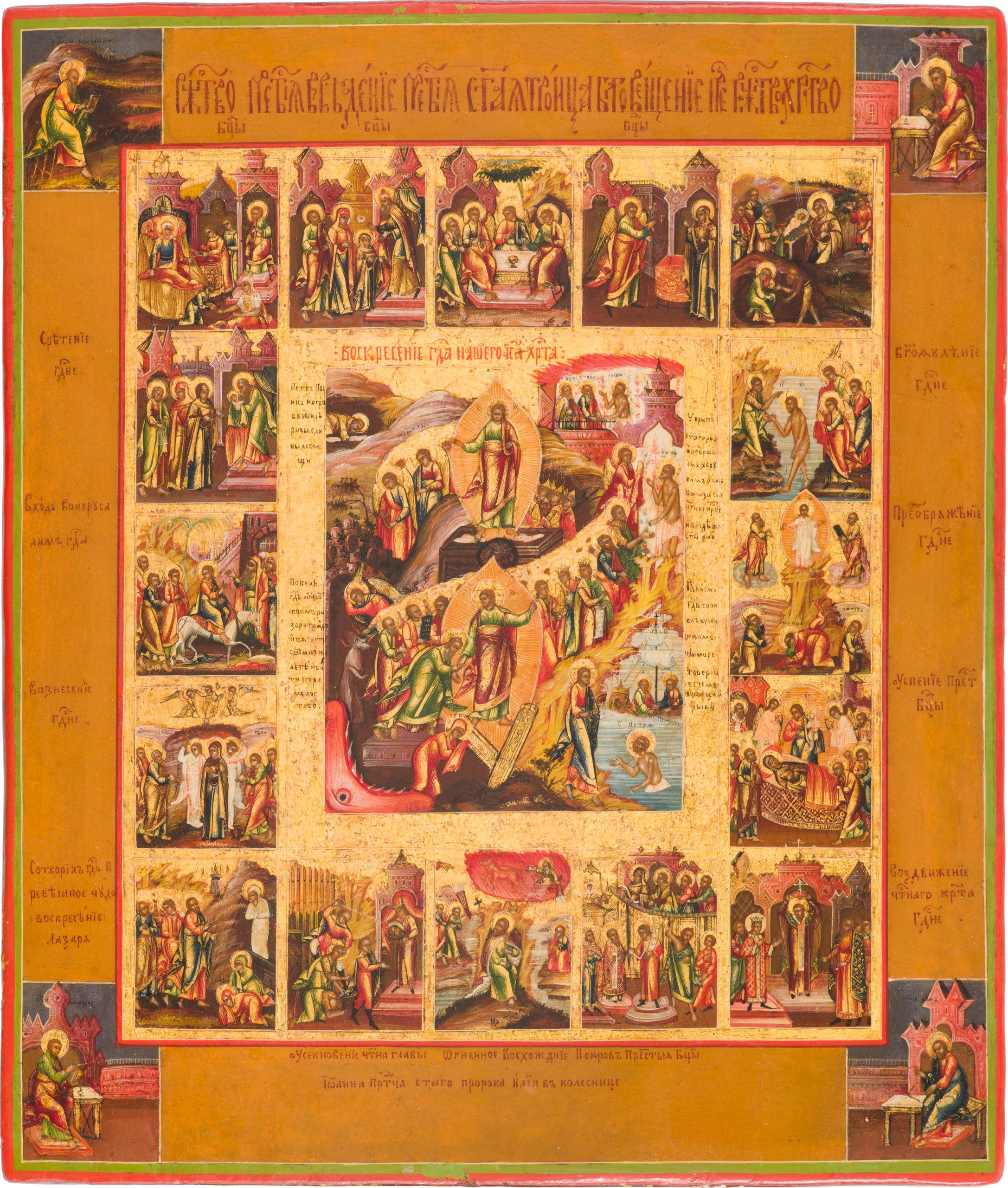
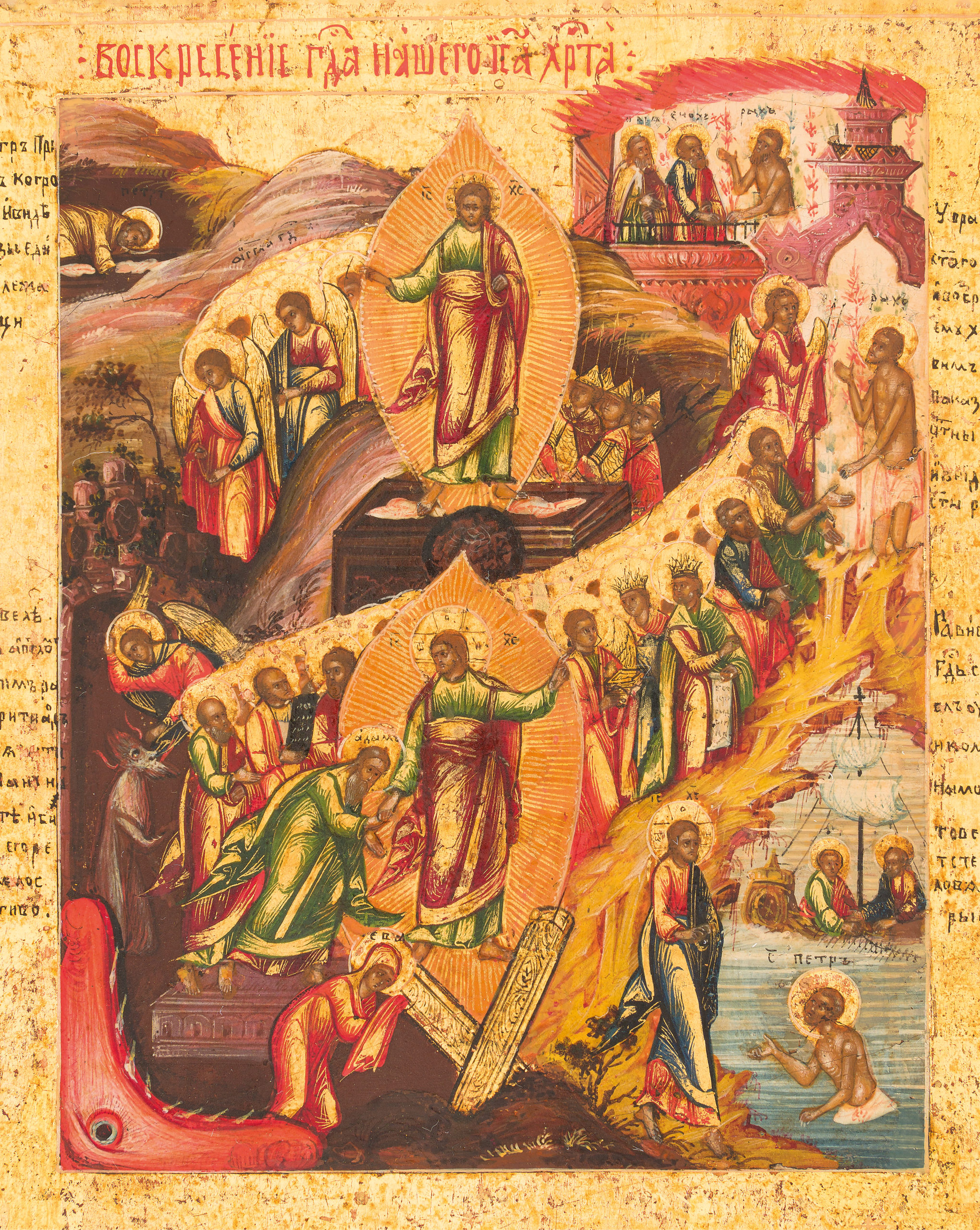
The Resurrection—the Descent into Hell, with Church Feasts in 16 Border Scenes and the Four Evangelists
Icon: second quarter of the nineteenth century. Palekh.
Size: 30 х 26 х 2.7 cm
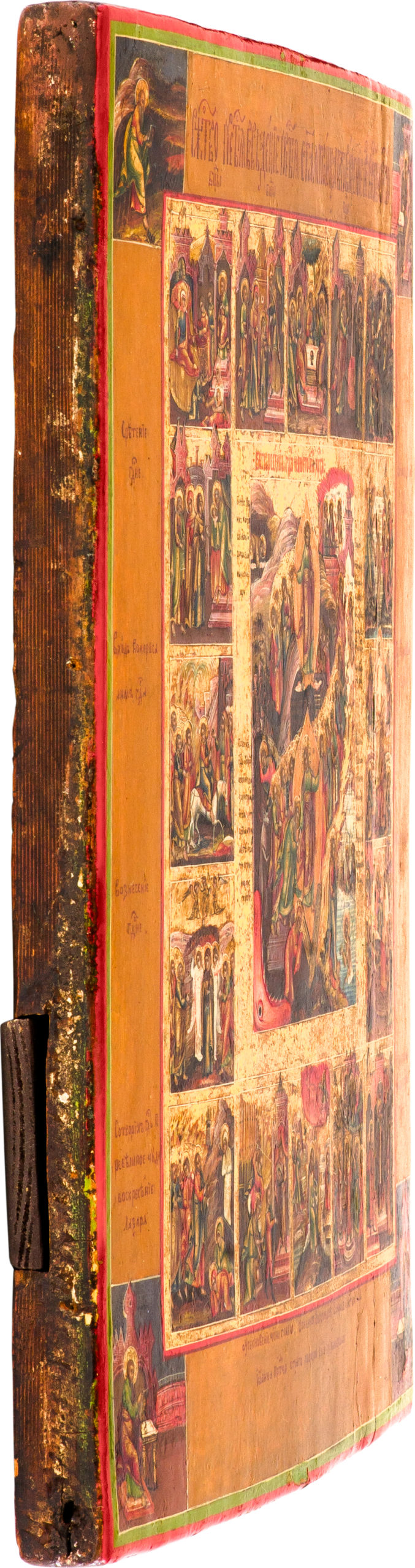
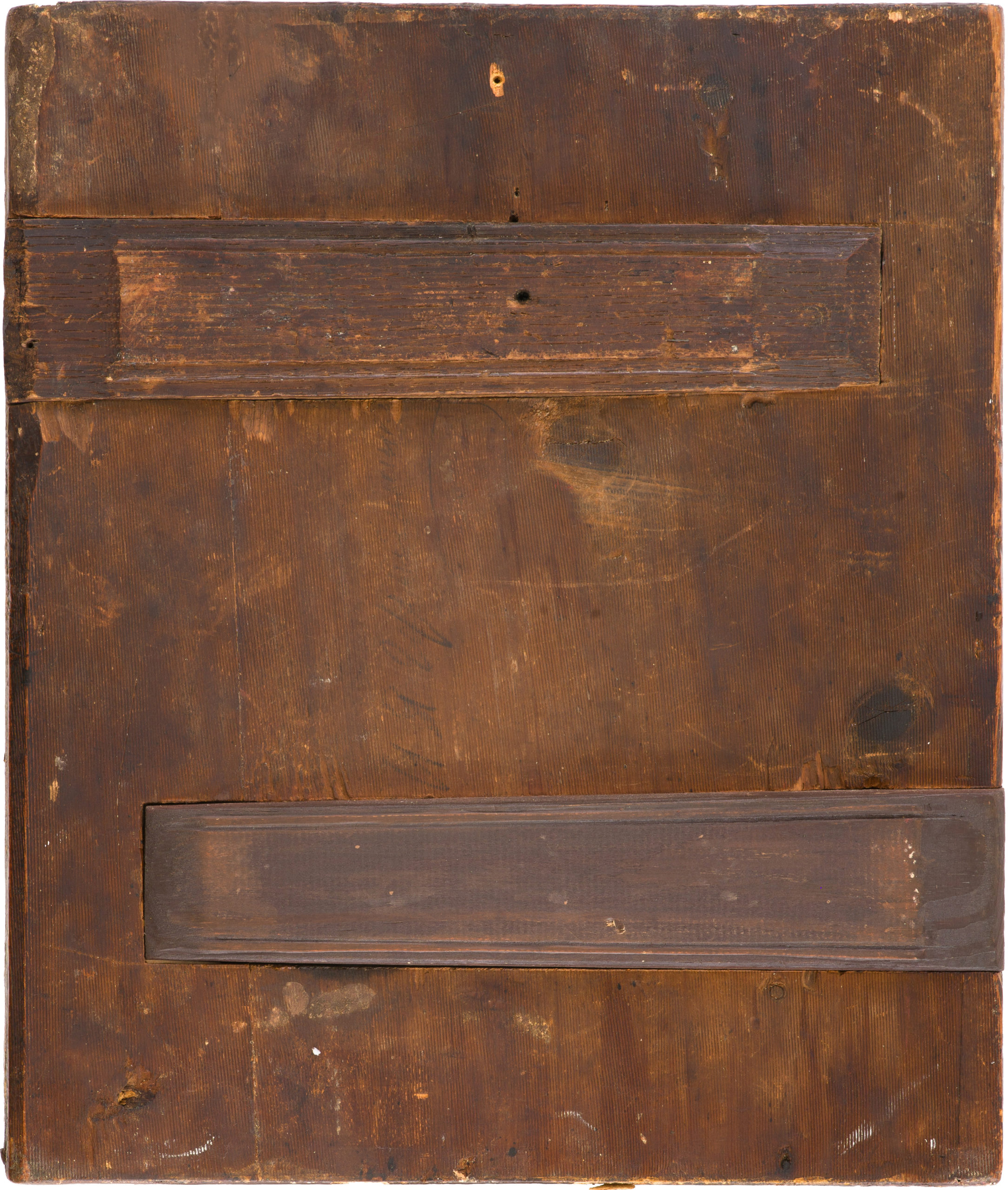
Wood (one whole panel), two incut support boards, absence of an incut centerpiece, underlying layer of canvas not visible, gesso, tempera, gilding.
The author’s paintwork is generally well preserved. There are small chips on the ends of the panel. There are also minor scratches on the gilding, inscriptions (especially on the gold background and in the upper right border scene with the image of Saint Matthew), and paint layer.
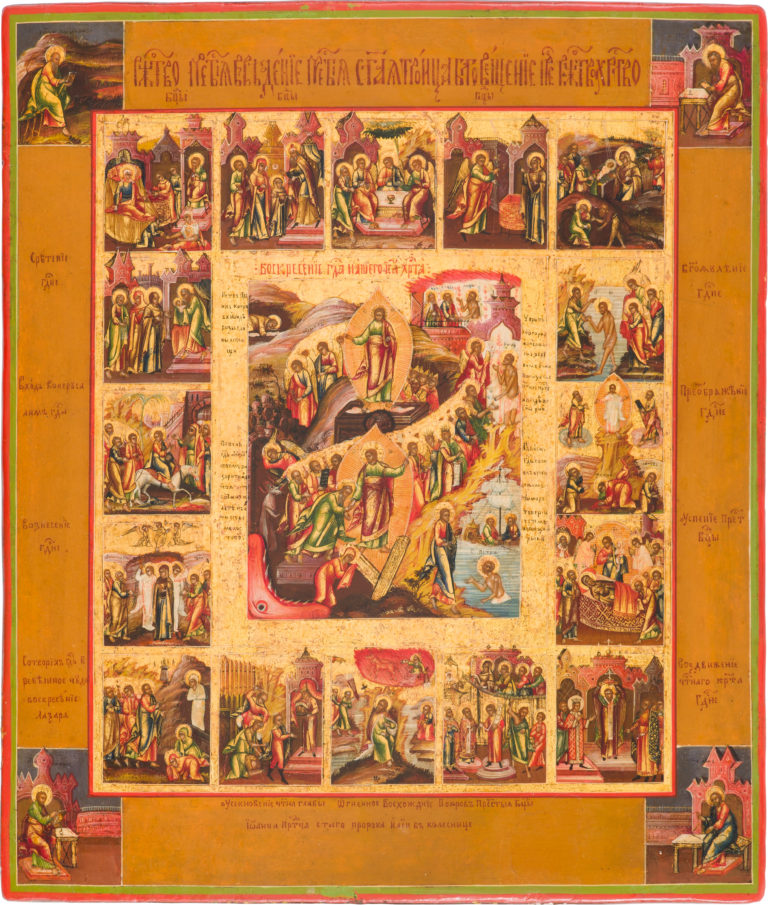
Diagram of the border scenes:
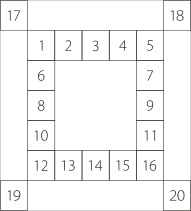
- The Nativity of the Mother of God;
- The Entrance of the Mother of God into the Temple;
- The Old Testament Trinity;
- The Annunciation;
- The Nativity of Christ;
- Candlemas (The Meeting of Christ in the Temple);
- The Theophany (The Baptism of Christ);
- The Entrance into Jerusalem;
- The Transfiguration;
- The Ascension;
- The Dormition of the Mother of God;
- The Raising of Lazarus;
- The Beheading of John the Baptist;
- The Fiery Ascent of the Prophet Elias;
- The Pokrov (Feast of the Protective Veil of the Mother of God);
- The Elevation of the Holy Cross;
- The Evangelist John;
- The Evangelist Matthew;
- The Evangelist Mark;
- The Evangelist Luke.
The published icon represents a traditional version of the Resurrection—Descent into Hell, structured around a classical vertical axis, with two images of Christ uniting the heavenly and earthly realms. The composition is enriched with additional scenes characteristic of the Palekh school, revealing the meaning of the Resurrection: Christ rose bodily, granting humanity eternal life, and even the Apostle Peter, who had betrayed Him but repented, is restored to his apostolic rank. The upper part of the composition is crowned by an image of the Trinity in the iconographic type The Hospitality of Abraham, which enhances the theological and artistic unity of the artwork.
The icon with feast scenes in the borders was executed in the Palekh workshop tradition and is distinguished by its refined painting and close attention to detail. The golden borders separating the central panel from the marginal scenes create the effect of a single, luminous space, while the exquisite rendering of landscapes, architecture, and figures—from blades of grass to marble sarcophagi—attests to the hand of a master of the highest level and to the icon’s origin in one of the finest Palekh workshops of the second quarter of the 19th century.