
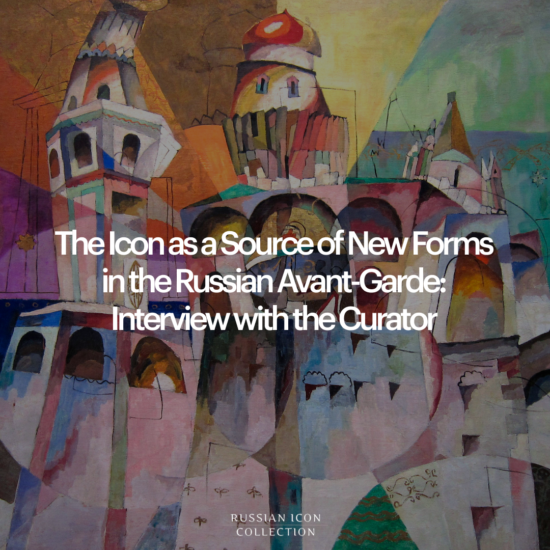
The Icon as a Source of New Forms in the Russian Avant-Garde
At the Tretyakov Gallery, the exhibition Avant-Garde and the Icon is on view until May 11, 2026. It reveals artistic parallels between two of the most celebrated phenomena in Russian art.
In an interview with Russian Icon Collection, the exhibition’s curator, Anastasia Likhenko, who serves as a curator of museum objects at the Department of Old Russian Art at the Tretyakov Gallery, spoke about the essence of these connections.
What fundamentally links the avant-garde and the icon? Which artistic devices did the avant-garde borrow from the Russian icon painting tradition?
Anastasia Likhenko:
The flourishing of the Russian avant-garde in the 1910s coincided with the rediscovery of the early Russian icon. The landmark 1913 exhibition of medieval Russian art, which showcased outstanding collections assembled by icon collectors, became a major cultural event. Around the same time, significant restoration discoveries were made, most notably the unveiling of Andrey Rublev’s Trinity. Thus, the search for a new artistic language and the formation of avant-garde aesthetics unfolded alongside new knowledge about the Russian Middle Ages.
The avant-garde sought to break with the academic tradition. Paul Gauguin, Pablo Picasso, Alberto Giacometti, and other early twentieth-century artists searched for new forms in non-European cultures. In Russia, one such source of a new artistic language was medieval Russian art. Henri Matisse held it in high regard. He encountered it while traveling to Moscow to work with Sergei Shchukin on the decorative panels Dance and Music. The Russian icon made a profound impression on Matisse. He later wrote that Russian artists did not need to seek inspiration in Africa or Asia, since they possessed their own ancient tradition—a source of non-academic forms and principles for working with image and color.
Indeed, artists viewed the icon as an alternative to the academic system, offering a different spatial logic and a new approach to color and composition. For instance, Alexei Grishchenko stated that modern artists should learn from the icon its handling of color and plasticity.
Discussions of twentieth-century art and the avant-garde often begin with Kuzma Petrov-Vodkin. Formally, he does not belong to the avant-garde and is usually classified as a Symbolist. Yet it is important to note that he trained in an icon painting workshop, which naturally influenced his artistic vision. He is not the only example. Vladimir Tatlin, an undisputed representative of the avant-garde, also worked in icon painting workshops.
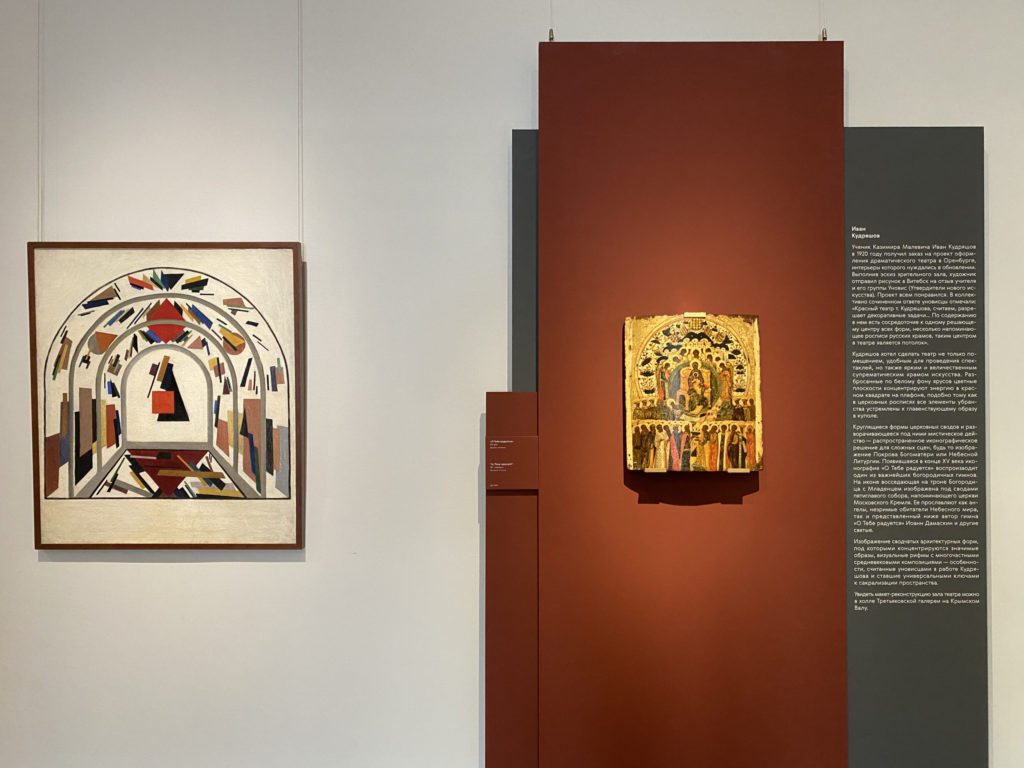
Photo: Igor Volkov
The avant-garde is often described as an era of manifestos. Are there texts in which avant-garde artists directly address the icon and reflect on its significance for modern art?
First and foremost, I should mention the programmatic text by Alexei Grishchenko, whom I have already referenced. Although he is difficult to classify strictly as an avant-garde artist, his position is essential for understanding the context. In his monograph, he analyzes in detail what the icon can teach the twentieth-century artist. It remains one of the most consistent texts on this subject.
Natalia Goncharova’s recollections are also significant. Raised in a religious, rural environment, she created a series of works on Gospel themes in which the medieval Russian tradition is reinterpreted through the logic of the avant-garde. Speaking about her artistic experience, she emphasized that everything she encountered—French art as well as the Old Russian tradition—became part of her own visual language.
In general, direct references to the icon are rare in avant-garde writings. Nevertheless, the icon became a crucial source that enabled the avant-garde to sever its ties to academic tradition and to construct a new artistic system.
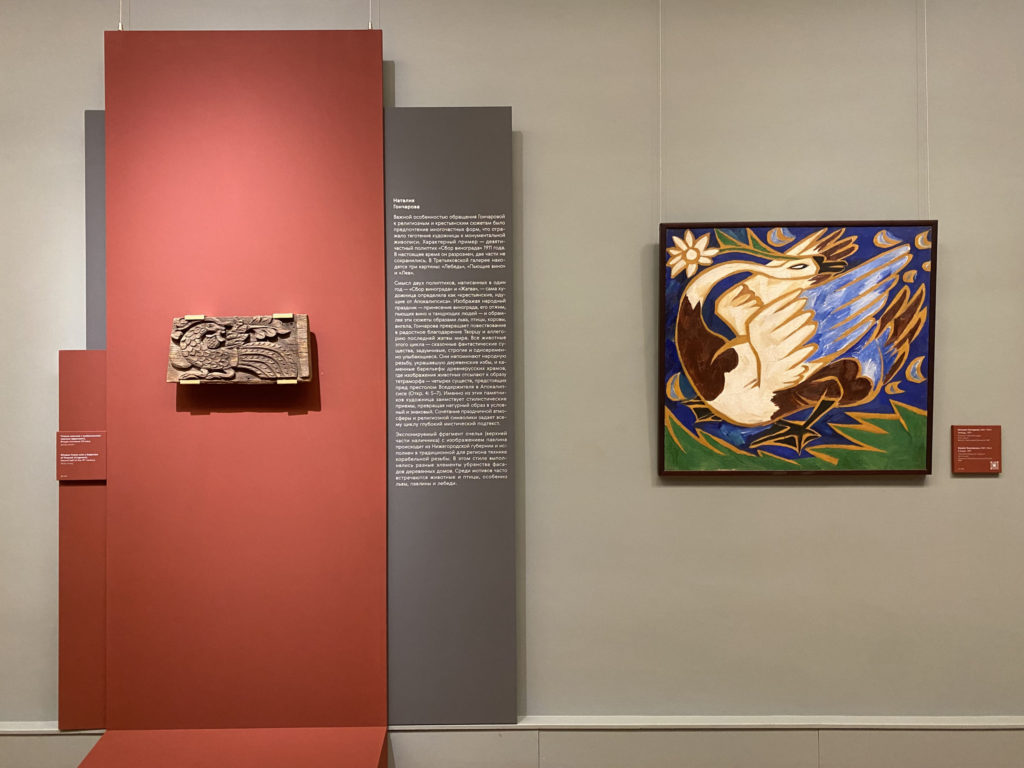
Photo: Igor Volkov
How did the relationship between the avant-garde and medieval Russian religious art develop under the Bolsheviks’ anti-religious policies after the Revolution?
This is a complex and ambiguous issue. Although state anti-religious policies unfolded in full force during the 1920s, this same period also witnessed active restoration efforts, scholarly study of Early Russian painting, and the establishment of museums and collections. Medieval Russian art was thus perceived not as an object of worship, but as an artistic phenomenon. In fact, this process began even before the Revolution, as evidenced by the 1913 exhibition.
In 1918, during the nationalization of private collections, the Commission for the Uncovering and Preservation of Old Russian Painting was established under the leadership of Igor Grabar, the first director of the Tretyakov Gallery after the abolition of its board of trustees. The commission included hereditary icon painters from villages in the Vladimir region, including Mstera. Alongside Grabar, the scholarly director was Alexander Anisimov, a specialist in Old Russian art who had previously worked in Novgorod.
The commission saved numerous artworks. Its members traveled to Novgorod, Vladimir, Pskov, Dmitrov, and Uglich, restoring frescoes, uncovering icons, and transferring them to museums. On this basis, the Central State Restoration Workshops were established—the country’s first professional restoration institution.
In the 1930s, the Central State Restoration Workshops were dissolved. Repressions began. Alexander Anisimov’s fate was tragic: he was first dismissed, then arrested, sentenced, and sent to the Solovetsky labor camp. Many specialists working with medieval Russian art suffered similar fates.
In a certain sense, the destiny of the avant-garde proved comparable. After the decree dissolving artistic associations in the late 1920s, the institutional foundations supporting the avant-garde were effectively destroyed. The movement ceased to exist publicly and retreated into obscurity.
Thus, both medieval Russian art and the avant-garde found themselves in a difficult and often tragic situation in the 1930s. There is a certain bitter historical irony in this parallel.
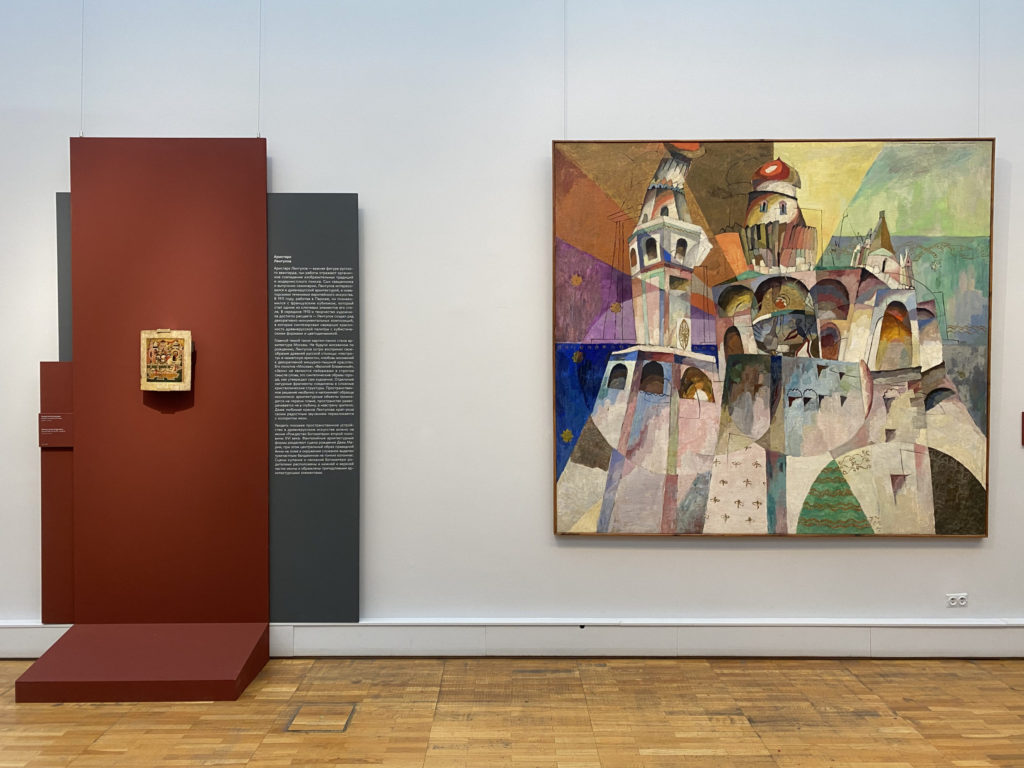
Photo: Igor Volkov
How were icons of the eighteenth and nineteenth centuries perceived at the beginning of the twentieth century? Did contemporary icon painting influence the avant-garde?
This question should be divided into two parts. Icons of the eighteenth and nineteenth centuries represented a living religious and artistic reality, as icons still formed part of everyday experience.
In the 1860s, the Poshekhonov workshop gained widespread recognition. Contemporaries perceived its activity as an attempt to revive something akin to the Byzantine tradition, although the connection with authentic Byzantine art was rather tenuous. Nevertheless, the idea of returning to national roots was highly significant. Russian identity was associated with the Middle Ages and Byzantine origins, while actual knowledge of early art remained limited.
At that time, there was little understanding of what twelfth- or fifteenth-century icons truly looked like. Rublev’s Trinity and the Vladimir Mother of God were still hidden beneath later overpainting. An idealized image of “antiquity” emerged—gold backgrounds, large eyes, stylized ornamentation—essentially reconstructions born of imagination.
This context gave rise to the Neo-Russian style. The murals of Saint Vladimir’s Cathedral in Kyiv, created by artists such as Viktor Vasnetsov, Mikhail Nesterov, and Mikhail Vrubel, offer a vivid example. These works did not reproduce medieval art directly, but reinterpreted it through the prism of Art Nouveau. As a stylistic tendency within church art, this development was extremely significant.
The situation with the avant-garde, however, was different. Avant-garde artists had far fewer direct connections with contemporary church practice and rarely engaged with ecclesiastical commissions. We know that Natalia Goncharova received such commissions, but these were exceptional cases.
The avant-garde was primarily a space of individual artistic exploration. Consequently, its artists turned not to nineteenth-century icon painting, but to medieval prototypes.